
A Camino Story
By Wayne Edney
©2025
Dedication
For Karen, my soulmate and fellow pilgrim. With you, the Way is the destination.
Foreword
Every truly great pilgrimage asks more of us than it answers. Easy answers close doors; powerful questions create possibilities. This story is the chronicle of a forty-six-day, 800-km walk across Spain in pursuit of those questions and possibilities, built upon the deepest kind of partnership defined by shared vulnerability, reciprocal support, and a unifying philosophical quest.
For Wayne and Karen, the Camino de Santiago is a sacred path where they do not seek fixed certainties of dogma. Instead, their journey is a relentless pursuit of questions about gratitude, continuity, humility, oneness, and the very nature of the Divine. From the physical shock of the Pyrenees, through the mental crucible of the Meseta, to the spiritual resolution of Galicia, they discover that the ultimate destination is not a place but an action. Their story is a demonstration of how simply putting one foot in front of the other can lead to powerful questions and new awareness.
Table of Contents
Section 1: A Physical Beginning
*Virgen de Orisson: Gratitude —Do past struggles intensify our gratitude?
* Roncesvalles: The Gift Passed Forward — How is gratitude passed on?
* Zabaldika: Choosing the Difficult Path — Which paths affirm true commitment?
* Rhythm of Love—How are partnerships achieved?
* Pamplona: The City of Exchanges — What are the real things of value?
* The Way of the Wind —Where is energy on the way found?
* Eunate: Geometry and Continuity — How does the past connect to the present?
* An Act of Love: A Mother’s Day Surprise — Can love be expressed over distances?
* Estella: The Wine Fountain — What is joy?
* Navarra: The Dynamic Becoming — Is it a Static Noun or Flowing Motion?
Section 2: The Meseta, The Mental Stage
* The Coop: The Pilgrim’s Question — Should we always believe authority?
* The Footsteps of the Past—Where do our steps meet those of ten thousand others?
* Villambistia: A Compliment — How do we value what is freely given?
* San Antón: A Hard Fall — How does a moment change the path to humility?
* Castrojeriz: Thoughts Surrendered — What is the measure of a pilgrim’s humility?
* The Slowing of the Way — Where is resilience forged?
* Sahagún: The Gift —How do we create the space for stillness and true service?
Section 3: Galicia, Spiritual Convergence
* León: The House of Light — How does the light get in?
* Villares de Obrigo: A Communal Dinner — What’s the meaning of the Camino?
* Cruz de Ferro: An Offering from the Heart — How do we express our blessings?
* Ponferrada: The Shield of Faith — How do we maintain spiritual integrity?
* O Cebreiro: A Timeless Moment — Where is truth confirmed?
* The Festival, and the Irony of Joy — Is pilgrimage stronger than worldly distraction?
* Santiago: The Arrival — Where does the Pilgrimage end?
* Finisterre: The Boundless Way — Which direction do we go when the arrows end?
*Bringing the Questions Home
Not the End just the Next Step
*The First Test
*The Slow Tempo of Home
*The Continuous Action of Giving
*The Defense of the Inner Path
*Lightening the Load
*New Pilgrims
* The Layers of the Way: A Deeper Canvas
*The Fifth Camino
Appendix: A Note to the First-Time Pilgrim
Section 1: A Physical Beginning
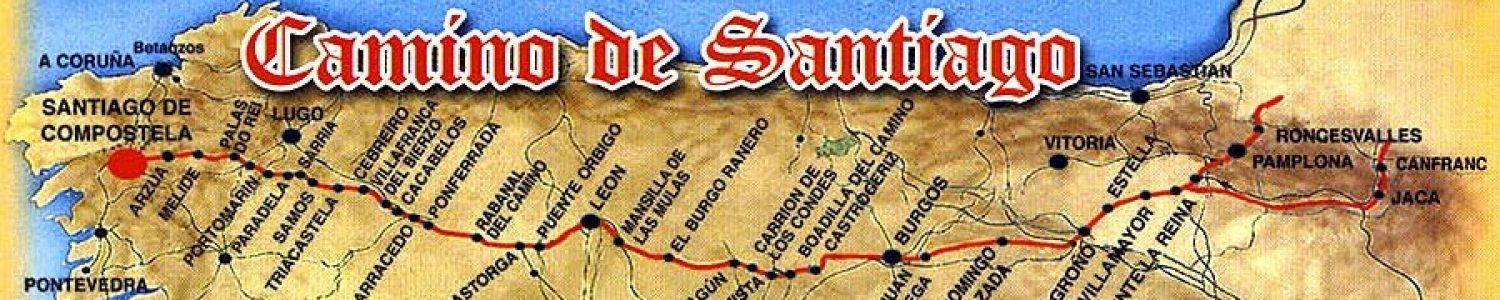
The Camino de Santiago, or the Way of St. James, is not a single path but a network of ancient routes across Europe converging at the tomb of the Apostle St. James the Great in Santiago de Compostela. The route followed in this chronicle, the Camino Francés, is the most historically significant and well-trodden, traversing roughly 800 kilometers (500 miles) through northern Spain. It has been a protected pilgrimage since the Middle Ages, recognized by the scallop shell, the universal symbol of the pilgrim, and marked by the iconic yellow arrows that guide the traveler forward. The Way endures not as a relic of the past, but as a living, continuous action, reinforced by every step taken by every pilgrim who joins the flow. It is a unique cultural and spiritual community where hospitality, shared burdens, and simple needs replace the complexities of the modern world. The first day is often cited as the most difficult of the entire route.
Virgen de Orisson: Gratitude
Do past struggles intensify our gratitude?
The Pyrenees Mountains made their demand instantly. The pre-dawn chill was a raw, crisp challenge as Wayne and Karen stepped onto the ancient path, a shared commitment to prioritize experience over distance. This was the start of their fourth long walk to Santiago, a ritual that would distill their lives for forty-six days into three pure actions—walk, eat, and sleep—stripping away clutter and enforcing a grounded mindfulness.
Climbing into the Pyrenees mountains, a quiet, profound gravity defined this morning. Wayne felt the heavy, sacred presence of the place, instantly recalling the sudden hypothermia experience from three years earlier. He remembered with fleeting clarity his shimmering glance through that “thin place” where the veil between Heaven and Earth is said to lift. His survival, aided by Karen and the selfless help of others, made today’s journey an act of profound gratitude. Reaching the small, unassuming statue of the Virgen de Orisson, Wayne paused. He placed a rosary over the Virgen’s arm, a tangible token of appreciation.
“Are you thinking about the last time we were here?” Karen murmured, adjusting the strap on her hip belt. Wayne nodded.
Now turning from the statue, his heart suddenly became lighter. He saw a herd of horses, their manes flowing in the wind. “Perhaps,” he thought, “these magnificent creatures are in recognition of my gratitude.” They were a bright, living gift, a stunning affirmation of the world’s beauty on this side of the veil, a fleeting glimpse of the sacred as a presence, not a promise.
“Look at them,” Karen whispered, pulling her phone out for a picture. “It’s like the world is welcoming you back. A living gift.”
“Exactly,” Wayne replied, starting to walk again. “This is the gift of motion unfolding before us right now.”
As the days passed, the journey became a full-sensory immersion into Spain. They were grateful not only for the rich aroma of coffee con leche from local bars and the sweet scent of lavender, but also the authentic notes of warm asphalt, dust, and sweat. Together they were ready to share their gratitude for everything they experienced. They wondered what other forms of gratitude they might find along the Way.
The sacred quiet of the mountaintops yielded to the sound of rushing streams, and the path soon funneled them toward the valley’s most monumental symbol of institutionalized welcome, a historic refuge where pilgrimage and hospitality first merged.
Roncesvalles: The Gift Passed Forward
How is gratitude passed on?
The sharp, relentless descent from the Pyrenees, a punishing drop that strains the knees, finally deposited them into the ancient halls of the Roncesvalles Albergue. Inside the massive, stone-walled chamber, a section of the historic complex was repurposed for hundreds of beds. It was thick with the distinct odor of damp wool, industrial cleaner, and well-earned sweat. Weary pilgrims moved with a slow, stiff gait. The main floor was a study in chaos. A long line snaked toward the small hospitalero’s desk; hikers huddled over phones, searching for signals; and near the entrance, a small, makeshift triage area was set up to deal with low-level injuries.
It was here, next to a crowded shoe rack overflowing with muddy boots, that they observed a young pilgrim struggling to manage a painful blister, the early, agonizing price of the trail.
Wayne stopped, watching the pilgrim wince as he pulled off a sweat-soaked sock. “Poor kid. That’s a bad one,” he murmured. “This place is built on the memory of that kind of suffering. It’s the first real lesson: take care of your feet.”
In that moment, Karen simply knelt beside the young man without speaking. The pilgrim, perhaps nineteen or twenty, looked up at her, his face pale with pain and embarrassment. His backpack lay haphazardly beside him.
“Un momento, por favor,” Karen said, her voice soft but steady, cutting through the low background noise of the hostel. She retrieved from her pack, Compeed, a specialized blister dressing that no serious pilgrim would be without. She examined the blister—a large, weeping bubble on his heel. “This is a big one,” she acknowledged, keeping her tone completely matter-of-fact. “We need to clean it first.”
She produced an alcohol wipe and gently dabbed the skin around the wound, ignoring his sharp intake of breath. “No te preocupes,” (Don’t worry) she continued, focusing entirely on the task. “I know exactly how this feels. But the important thing is we stop it from getting worse.”
She cut the Compeed precisely and applied it, pressing the edges firmly onto his clean, dry skin. The relief was almost instantaneous , and the young man’s shoulders dropped.
“Someone else once helped me on my first day, right when I thought I had to stop,” Karen explained, giving him a gentle tap on the knee. “Now it’s my turn to help you.”
The pilgrim’s relief and gratitude were immediate. “Gracias, gracias. Eres un ángel.”
Helping Karen to her feet, Wayne squeezed her hand. “That was amazing,” he reflected. “What you did is the whole point of our journey, isn’t it? Stripping away everything until all that’s left are simple needs and simple giving.”
Karen nodded, her smile warm. “The Camino’s true reward is simply the thousands of little, essential gifts we can pay forward every day. It’s a way of life, not just a walk.”
Zabaldika: Choosing the Difficult Path
Which paths in life affirm a true commitment?
The next day, between Roncesvalles and Pamplona, they reached a small village where the path signs became confusing. One set of markers led easily along a lower road, smooth and direct, while another, fainter set pointed upward toward a steep, muddy trail to the ancient Iglesia de San Esteban in Zabaldika. The lower route was the recent addition; the upper was the original, historically significant Camino Francés.
Wayne looked from the flat road to the steep, muddy climb. “Well, there’s the easy route, and there’s the one that old hospitalero in Roncesvalles insisted was the original route. He called it the pilgrim’s test.”
“The easy way is tempting,” Karen admitted, tightening her boots. “But remember what he said? A pilgrim follows the original way, even if it’s inconvenient.” She gestured up the muddy slope. “This is a commitment. Anyone can walk the flat road.”
Wayne shrugged off the temptation of the lower road.
Standing beneath the 13th-century stone church tower, they found a quiet albergue, managed by two Sisters of the Sacred Heart. The church itself felt immensely solid, its thick walls built centuries ago, some say, to withstand raids. Inside the tiny, ancient space, one of the nuns offered them a blessing. It was a beautiful moment of deep sincerity, an expression of love and an acknowledgment of their shared humanity.
They were then invited to climb the tower and ring the bell, a long-standing pilgrim’s privilege to announce their arrival and offer thanks. The bell tower housed two bells; one, the smallest, is rumored to be the oldest in Navarre. The larger one had a visible crack, so pilgrims were directed to the smaller. Wayne grasped the rope and pulled it once; the sound was a triumphant, honest ring that affirmed their gratitude for this journey.
After descending, they paused at the church’s focal point: a beautiful, life-like crucifix not mounted high above, but at eye-level. It was surrounded by hundreds of small green post-it notes, prayers and messages of hope, gratitude, and petition left by pilgrims from around the world. It was a silent, powerful testament to the community of faith and struggle that bound all those who passed through Zabaldika. Without speaking, Karen wrote on a post-it and added it to the wall. This small church was a living sanctuary, constantly being renewed by the intentions of the pilgrims who made the difficult climb to find its peace.
The Rhythm of Love
How are partnerships achieved?
Leaving Zabaldika, the path had leveled out onto a dirt road. For perhaps a quarter of an hour, conversation had ended replaced by the soft, rhythmic sound of four worn boots striking the Spanish earth. Crunch. Crunch. Crunch. Crunch.
Wayne hadn’t been paying attention to his feet, but a sudden feeling of effortless momentum made him look up. He saw that he and Karen were walking step by step, perfectly side-by-side. They had achieved a synchronicity that was deeper than any verbal agreement.
“We are in sync,” Karen whispered, recognizing the quiet magic of the moment.
“It’s effortless,” Wayne replied. He understood that to maintain this harmony, both of them were making constant, subtle adjustments—slowing or quickening their pace by mere millimeters to hold the shared rhythm.
He saw the truth clearly: Love wasn’t a static ideal or a vow; it was this sustained, continuous, deliberate action of keeping in time with each other. The highest demand of a partnership is the commitment to stay in step, proving that the rhythm of love on The Way was simply the act of walking together.
The path soon widened, flattened, and merged with a growing current of local traffic and commerce, a clear signal that they were rapidly approaching the noise and demands of the modern world.
Pamplona: The City of Exchanges
What are the real things of value?
The journey out of the quiet valley and into the walled, medieval capital of Pamplona was a jarring shift. The city, famous for its grand historical structures and for the chaos immortalized by Hemingway’s early novels, demanded a different kind of presence. Wayne and Karen were looking forward to a brief reprieve. Wayne paused near the Bullring, where a statue of the author stood. It was a permanent nod to the fame the city traded on. He stepped toward a vendor selling beautiful, hand-painted scallop shells.
Just as he was about to select one, he noticed a local shop owner, a stout man in a flour-dusted apron, struggling desperately outside his doorway on a narrow side street. The air, heavy with the scent of old bread and warm asphalt, seemed to vibrate with the man’s silent effort. He was trying to move a heavy, oversized crate of supplies, far too much weight for him to manage, up the steep, narrow steps into his small panadería. The man’s face was scarlet beneath his graying hair, and the strain on his brow was palpable. His breath came in short, painful gasps.
Forgetting the souvenir, Wayne walked over instantly. The shop owner, focused on the task, barely registered his presence. Wayne simply grabbed the other end of the wooden trunk. “A dos,” Wayne grunted in Spanish, signaling the need for two people.
The owner nodded a silent, grateful assent. With a unified, heavy effort they lifted the immense burden. The sound of their shared grunt and the wood scraping the stone was the only noise as they carried the crate up the worn steps, one at a time. Panting, the shop owner wiped his brow with the back of his hand, leaving a smear of flour across his forehead. His eyes, though still tired, were bright with immediate, intense relief.
“Thank you. You saved my back. ¡Mil gracias! You are a true pilgrim.”
Wayne returned to Karen; the shell vendor had disappeared. It was siesta time.
“The shell would have been a nice souvenir,” Karen observed, looking at his sweaty forehead and the dust on his shirt.
“That shell was nice,” Wayne said, stretching the ache out of his back. “But the struggle of that shared labor, the action of putting my strength into his burden and the deep, instantaneous gratitude that shop owner expressed, that’s the important thing. That memory, that exchange of grace, is the only souvenir I need to remember today.”
The Way of the Wind
Where is energy on the Way found?
The ascent to the Alto del Perdón felt like a vertical exclamation point. For forty minutes, the climb was a sustained, relentless push against gravity, and as they reached the high ridge, the landscape opened up dramatically. Massive wind turbines dominated the sky, their huge, elegant arms spinning with relentless, indifferent energy, a modern echo of the ancient, invisible power that moved the world.
Standing at the summit, with the iconic steel sculpture of pilgrims marching into the primal force of the wind, Wayne felt both exhilarated and tested. The wind was a chaotic, elemental force, whipping around them and demanding attention, even forcing them to lean into their poles for balance.
Wayne raised his voice over the howl. “Look at this! The entire universe is turning right here.” He gestured to the vast, revolving arms of the turbines. “It’s a physical metaphor for the action of a world in constant motion.”
Karen pulled her fleece collar higher, her eyes fixed on the historic message engraved upon the monument: “Donde se cruza el camino del viento con el de las estrellas”—Where the path of the wind crosses with that of the stars. “It’s beautiful, yes, but it’s an external power, Wayne,” she shouted back, leaning closer. “Look at us. We have to fight it to stay standing. I’d rather draw my energy from somewhere I can control.”
Wayne nodded, feeling the tug-of-war between the wind’s external power and his need for internal focus. The energy of the summit, the grand spectacle of the turbines and the wind, was immense, but it was also chaotic.
Continuing their walk down the other side of the ridge, the wind dropped away entirely, replaced once again by the soft, steady, rhythmic shuffle of their own boots. Wayne reached back and squeezed Karen’s hand as they walked shoulder-to-shoulder, falling back into a perfect, quiet synchronicity.
“Right here,” he murmured, the noise of the summit suddenly feeling distant. “This is the kind of energy I can sustain.” The true power, he realized, wasn’t the wind, a noun, a force they could only endure, but the small, constant, interlocking dynamic between them. Their ability to stay side-by-side, to once again match their steps without speaking, was their own personal, human answer to the universe’s chaotic motion. It wasn’t a static ideal; it was the action of simply walking, a choice made with every step. The true Way wasn’t a place where the wind crossed the stars; it was where their steps matched each other.
Eunate: Geometry and Continuity
Is there a spiritual path that connects the past to the present?
The path led them on a quiet detour to the Ermita de Santa María de Eunate, a rare and haunting octagonal church surrounded by an elegant gallery of arches. The architectural geometry was unlike anything they had seen, suggesting a historical link to the Knights Templar. Standing beneath the ancient arches, Wayne felt the profound weight of continuity. This seemingly permanent stone structure was a testament to a protected route built and sustained by generations.
Wayne stopped beneath the gallery, looking up at the perfect, eight-sided stone mandala. The very structure seemed to be an effort to contain the Divine, to hold the essence of faith in static perfection. The builders seemed to have tried to arrest the flow of time, offering a permanent object of devotion. He thought of his own philosophical quest, his search for the Divine not as a permanent object but as flowing motion, the eternal verb of walking. He tried to reconcile the two.
He slid his pack from his shoulders, allowing it to drop to the dry earth, and sat on the low stone ledge of the gallery. He willed himself to be perfectly still, to pause.
Karen, watching him, walked the perimeter beneath the gallery, the rhythmic shadows of the arches falling and dissolving as she moved. “They built this to last a thousand years,” she said quietly, her voice echoing slightly off the columns. “A physical declaration of faith in the future. A thing to look at.”
Wayne shook his head, pushing himself back to his feet. “It’s not the stone that lasts a thousand years, Karen. It’s the approach to the pilgrimage itself.”
He grasped the truth clearly: The octagonal geometry was a structured monument, a perfect pause designed to capture the attention of a weary traveler and redirect it temporarily inward, so the traveler could finally understand his journey not as a distance to be conquered, but as a series of deliberate, single movements.
He looked up at the eight sides again. The mandala wasn’t a circle, but a series of eight short, straight lines. The builders hadn’t arrested the flow of time at all; they had simply broken the continuous arc of the circle into distinct, manageable steps, each perfectly placed to lead to the next. The structure taught him that the path’s continuity was not guaranteed by the stone, but by the conscious decision to place one perfectly deliberate step after the last. That responsibility was what truly lasted a thousand years. He picked up his pack, the weight feeling less like a load and more like a tool.
Wayne and Karen left Eunate with a last, grateful glance at its elegant symmetry. The dusty path they walked on now was suddenly imbued with the knowledge that its simple course was supported by the strength of that unbroken history. The octagonal church had connected them to the past, clarifying that the immense task ahead could be completed by just focusing on a single, perfectly deliberate day, placed to lead to the next.
An Act of Love: A Mother’s Day Surprise
What kind of power do our greatest connections bring us?
The Camino soon carried them out of the quiet valley and into the medieval town of Estella. It was a bustling contrast to the silence of Eunate, its old streets echoing with modern life layered upon centuries of pilgrimage and commerce.
Wayne and Karen checked into a quiet monastery. A soft knock came on their door. When Wayne opened it, a local woman stood there holding a tall, rectangular box wrapped in simple brown paper. It was a delivery for Karen.
Confused, Karen quickly unwrapped the package. Inside was a clear, protective plastic box, and nestled within it was a single, perfectly preserved red rose. A small, neatly typed message was taped to the inside. They leaned close to read the words from their children, Annalise and Erik.
“Happy Mother’s Day, Mom. Congratulations on making it this far. This rose is preserved so you can carry it on your backpack and think of us every time you see it.”
A warmth that had nothing to do with the day’s sun filled the small room. Mother’s Day, celebrated earlier in Spain than in their home country, was a date they had nearly forgotten. The logistical effort, the research, the coordination with a local florist via text message, the precise timing, and the packaging required to deliver a single, fragile flower to a remote monastery on the Camino was astonishing.
Karen lifted the beautiful, boxed rose, tears welling in her eyes as she held the message. “They’re walking with us,” she whispered, turning to Wayne. “They didn’t just send a message. They engineered a moment of pure love.”
Wayne nodded, paraphrasing a quotation he had once heard. “God spoke to us today in a flower,” he said, touching the smooth plastic protecting the bloom. “That rose isn’t a thing. It’s the action of their love moving across an ocean and down a thousand-year-old path to find you.”
With Wayne’s help, Karen carefully strapped the clear box to the outside of her pack, placing it where the deep red of the rose would be visible above her shoulder. It was a permanent, constant reminder that the journey was not just a pursuit of self, but a continuous expression of the deep connections they carried with them. The walk continued, now with a new, bright shield of love on her back.
Refreshed by this unexpected spiritual gift, their steps felt lighter as the path led them onward through the sun-drenched vineyards, where the promise of another great, ancient act of pilgrim hospitality awaited. The famous Wine Fountain was just ahead.
Estella: The Wine Fountain
What is joy?
Early in the morning, the trail led them out the other side of Estella and a familiar sense of anticipation grew, fueled by the rising sun and the crisp air.
On the wall of a modern bodega, they found it: the legendary Wine Fountain. Two taps were set into the stone, one dispensing clear, cool water, and the other, free-flowing red wine. A quiet, cheerful queue of pilgrims had already formed, the bottles and scallop shells held out almost reverently.
Karen joined the line. She watched the dark ruby splash into a German pilgrim’s plastic cup, the sound muffled and rich. When it was her turn, she filled her cup from the wine tap. The aroma was rich and earthy, a dark fruit note hanging on the cold morning air. Lifting the cup, she read the inscription engraved nearby: “Pilgrim, if you wish to arrive at Santiago full of strength and vitality, have a drink of this great wine and make a toast to happiness.”
Karen raised her cup to Wayne, who had opted for water, but whose eyes held a deep, knowing smile. “To the Way,” she toasted, drinking the wine. It was fresh, simple, and perfectly revitalizing. It was a momentary indulgence, a celebration of the miles already covered. It tasted like the region, like the road, like a promise kept, a fleeting moment of pure grace that answered the morning’s question: joy was this small reward, shared on the path.
Navarra: The Dynamic Becoming
Is it a Static Thing or a Flowing Motion?
Walking next to Karen, Wayne tightened the strap of his worn backpack, its familiar pressure a comforting counterweight. The rhythm of his boots now marked a pilgrimage not just of distance, but of unfolding movements: the slow, steady swing of his arms, the quiet thud of trekking poles hitting the gravel. The air was a clean mixture of damp earth momentarily sweetened by the faint, earthy perfume of sun warmed Riojan vineyards.
They paused at a magnificent, mossy medieval stone bridge, its arch worn smooth by centuries of pilgrims and the powerful, forgotten floods of spring. Below, a cold, clear stream rushed over stones the color of rust and charcoal, tumbling down toward the valley floor.
He stared down at the rushing water, momentarily hypnotized by the ceaseless motion, and a profound realization struck him. He looked up at Karen, the sun glinting in the profound look in his eyes. “I think I’ve been getting it wrong.”
“Getting what wrong?” she asked, tying her hair back. The sound of a village church tower bell chiming the quarter-hour drifted up from the valley, a sound both ancient and immediate.
Wayne gestured toward the torrent below. “My entire life, I’ve thought of the Divine as a static noun, God. A fixed, settled ideal waiting at the end of the journey, like a statue in Santiago.” He took a deep, reflective breath. “But it’s not. It’s the constant, undeniable change of the world itself. It’s the water moving over those stones, carving new paths, never holding the same shape for even a second. It’s the rhythm of our poles and boots. It’s the sheer flow of life.”
He felt the insight settle in, weighty and true. “The pilgrimage isn’t about reaching the endpoint. It’s about being present in the ceaseless becoming of everything—the shifting trail underfoot, the water passing, the body adapting. Like the water, that flow is the action and the true prayer.”
He turned from the bridge, a fresh, energized purpose setting his shoulders. For a lifelong seeker, this simple river had clarified everything: the Way was not a map to be followed, but a verb to be lived.
Later that day, huddled in a refuge kitchen, they listened as a young woman from Tibet spoke of the essential nature of all existence or Tathata, as she called it. She used words and concepts utterly foreign to Wayne’s Catholic upbringing, yet the core feeling, the profound spiritual yearning for truth, was instantly recognizable. They realized that humanity’s sacred words, Father, Brahman, Allah, The Way, were all nets cast into an ocean searching for something that could never be fully contained. These words were rich metaphors, each a different lens focusing on the same universal truth that flows through all things. The greatest risk, Wayne thought, wasn’t using a different word for the sacred, but trying to stop the flow and turn it into a rock. The wisdom is not to be found in a word, but in the humility to stay in motion, forever adapting to the current.
Together they realized that the Divine wasn’t waiting in Santiago, it lived with them each day in the very act of walking.
Section 2: The Meseta, The Mental Stage
Leaving the last of the mountainous foothills behind, Wayne and Karen descended onto a landscape unlike any other they had encountered: the Meseta. This was the vast, open, high plateau of Spain. The previous weeks had tested their bodies. This new terrain would test their minds.
The Shadow and the Pace
How does the constant motion of the body influence the stillness of the mind?
The Meseta offered nothing for the eye to distract the mind, which was its subtle strength. The horizon was an endless, flat line, and the sun was relentless. After three hours of walking, the silence became so intense that Wayne stopped listening to the path and started listening to himself.
He looked down, mesmerized by his own shadow. It was long and lean, a precise, dark echo of his body, perpetually falling forward in front of him. The moving shadow was an action, not a thing. It never wavered, never stopped, and never looked back. Its only purpose was to confirm his current movement.
Walk, walk, walk. The only way to escape the monotony of the Meseta was to lean into the monotony of the movement. Wayne began matching his breath to his steps: Inhale for three steps, exhale for three steps. He focused on the rhythm of his own shadow, realizing it was his most loyal companion.
Another profound insight arrived without fanfare. He realized that the body, in its relentless, repetitive motion, was creating a space for mental stillness. The mind had nothing left to latch onto, no distraction, no view, no sound, except the constant, hypnotic action of each step. The act of walking was generating an opening for a moving meditation. In the face of overwhelming monotony, the self was being revealed as sufficient. His mind was at peace without external distraction.
The road carried them deeper into the Castilla y Leon region, the continuous action of their feet taking them toward a town where the intersection of the spiritual and the absurd—was manifest. It was a place where the line between historical faith and joyful absurdity was preserved, appropriately enough, in a wooden coop
The Coop: The Pilgrim’s Question
Should we always believe authority?
The air inside the cathedral of Santo Domingo de la Calzada was cool, heavy with the scent of old stone and frankincense. The crowds had thinned for a moment, and Wayne and Karen stood quietly before the elaborate, Gothic chicken coop, its brass bars gleaming in the dim light. Inside, a snowy white rooster and hen pecked with indifferent dignity.
Karen leaned in to read the detailed plaque. “The sign says the whole thing started because a young German pilgrim, Hugonell, refused the advances of the innkeeper’s daughter. She got her revenge by slipping a silver cup into his bag, then accusing him of theft. A simple lie and the boy was hanged.”
“A terrible injustice,” Wayne muttered, his gaze fixed on the birds. His own life as a pilgrim often led him to ponder the great themes of justice and faith.
“But the miracle is even better,” Karen continued. “The parents, heartbroken, stop on their return trip to say goodbye to his body, and they find him still alive on the gallows, saved by Saint Dominic. They rush to the magistrate, who is in the middle of a chicken dinner, and he dismisses them with that famous line: ‘Your son is as alive as this roasted rooster and hen on my plate.”
Wayne finally spoke, placing his pilgrim’s trekking poles gently on the stone floor. “It’s not really about the miracle, is it?” Karen looked at him, recognizing the reflective tone. “What do you mean?”
Wayne motioned toward the coop. “Think about the three dead things in that story: The young man, who was wrongfully condemned and hanged, the hope of his parents, which was entirely lost, and the roasted chickens. The magistrate—the worldly authority—dismisses all three. He basically says, ‘Your hope is as dead as the dinner on my plate.’ And then, the dead things come alive.”
“The lie is undone, the life is returned,” Karen thought. “The miracle is a reversal of an injustice.”
“More than that,” Wayne said, his voice gaining energy. “That moment, when the dead birds live, that’s the entire experience of the Camino, isn’t it? Pilgrims arrive carrying the weight of something: a loss, a fear, a doubt, something that feels finished and roasted. And somewhere along the way, that dead thing starts to flutter and crow again. This coop is a physical, clucking reminder that there’s always life, even when the world, or the local magistrate, tells you your journey, your faith, or your hope is done.
“And it teaches you to question.” Karen added, pulling him gently back toward the door. “Never trust the guy eating roasted chicken when he tells you your hope is dead.”
As they stepped into the sunlight, Wayne paused at the threshold. He didn’t tap his foot or adjust his pack; he just looked back at the cathedral, where the two indifferent white birds pecked at the stone floor. The absurdity of life and death, hope and doubt, all existing at once, was the lesson. The real insight wasn’t a philosophical answer, but the recognition that hope and doubt live together in the same moment. “Well, if a chicken can come back to life, and a hanged man can hold on, I guess I can handle another hill. The message is clear: keep walking, even when things look cooked!” He adjusted his pack, no longer sure what to call the feeling, but ready to keep walking anyway.
The Footsteps of the Past
Where do our steps meet those of ten thousand others?
The Meseta’s path was not paved, nor was it always maintained. It was simply worn. Day after day, as the sun climbed higher, Wayne found his attention drawn not to the distant horizon, but to the dust directly beneath his feet. The thin soil was pulverized almost to a fine talc. When the wind didn’t kick it up, the dust was silent and heavy.
He realized he wasn’t walking on dirt; he was walking on a thousand years of history. This fine powder was the sediment of footsteps: the pulverized remnants of Roman military roads, medieval hooves, and countless boots from pilgrims of every century.
One afternoon, Karen paused to tie her shoelace next to a deep rut carved into the path. It was a faint, shallow groove. “Look at that,” she said, pointing to the depression. “It’s too smooth to be a water channel. It looks like it was cut by cartwheels.”
Wayne knelt down, touching the ancient depression. It was the mark of continuity—a physical scar left by centuries of now anonymous travelers. He stood up, his gaze sweeping the empty plains. He knew that the very action of his feet striking the ground was not new; it was merely the latest echo in a sequence that stretched back to the middle ages. His walk was not an act of solitary effort, but a communal movement shared across millennia.
“We aren’t creating the path,” Wayne mused, adjusting his pack. “We are simply joining the path. The Way is a living entity, constantly being reinforced by the action of participation.”
He smiled at Karen, the weight of history suddenly feeling like support, not pressure. With that realization, the were joined not only by their own rhythm, but by the quiet, accumulated steps of tens of thousands of pilgrims whose journeys had been compacted into the very earth they walked upon.
Villambistia: A Compliment
How do we value what is freely given?
The next day after walking for over two hours, Wayne and Karen stepped inside a brightly lit Spanish bar, taking in the warm atmosphere and the delicious scent of coffee. Approaching the long counter, Wayne greeted the owner, Carlos, with a simple “¡Hola! Dos cafés, por favor.” He requested a strong Americano, while Karen asked for a café con leche. When Carlos asked if they wanted something to eat, “¿Y algo de comer?”, Wayne’s eyes settled on the thick, inviting potato omelet. “We’ll split a slice of that tortilla. Looks like it was just made.” Carlos quickly prepared their drinks and placed a rich slice of the tortilla on a plate, wishing them a good meal.
After quickly finishing their coffees and tortilla, the couple carried their empty cups and clean plate to the bar. “The tortilla was absolutely delicioso,” Wayne told Carlos, who revealed it was his mother’s recipe. Karen enthusiastically added, “Thank you so much!” Wayne offered a final endorsement, telling Carlos it was the best they’d had on the Camino so far: “¡Estaba delicioso!”
Carlos’s reaction wasn’t pride; it was genuine, slightly stunned pleasure. “Gracias, peregrinos,” he said, wiping his hands on his apron. As they left the bar, Carlos called to them, offering a final blessing, “Vayan con Dios.”
“Vayan con Dios,” Karen whispered back departing the town. “Go with God.” Wayne squeezed her hand. We already have, he thought. We already are.
Wayne and Karen walked out into the cool morning, their steps energized. “He meant that,” Karen observed, adjusting her pack straps. “A simple compliment was a greater currency to him than the price of the coffee.”
Wayne nodded, feeling a quiet sense of satisfaction. “We keep trying to define the sacred as a great, overwhelming thing like the Pyrenees or the cathedral,” Wayne mused. “But maybe the Divine isn’t the grand gesture, it’s the smallest action of genuine appreciation.” He paused, watching the dust catch the morning sun on his boots. “The effort to articulate thanks, to put a value on someone’s unseen labor… that was the real exchange of grace on the Way. But what happens when the ‘thanks’ fades? Is the verb only momentary, or is it a continuous commitment that we must defend even from our own exhaustion? We gave that gift, but the hardest part will be sustaining the giving.
San Antón: A Hard Fall
How does a moment change the path to humility?
Late in the day, they reached the ruin of San Antón. As Wayne and Karen approached, passing beneath the impressive Gothic archway of the ruins, the air inside felt profoundly still.
Looking at the bare stone where the altar once stood, Karen whispered, “This place is all about a special kind of grace. Monks risking their lives to heal the sick.”
“Right,” Wayne agreed, his voice low. “The specialized action of healing. It underscores the deep truth that grace often manifests not as a single miracle, but as relentless, dangerous, sacrificial labor. That’s the most powerful kind of all.”
They moved forward. Looking upward, the rose-shaped window above the altar had long since lost its stained glass. Yet, as the sun began to set, a pure orange light streamed through the empty spaces, casting a perfect, rose-shaped glow, a bright stencil of light, on an adjacent wall. In that moment, becoming the sum of every pilgrim who had ever stood there, they knelt, not in prayer, but in recognition of the timelessness that enveloped them. In that shared experience, the calendar, the watch, the whole brittle structure of human time simply dissolved. They were observing the moment as a permanent, unchanging reality.
Rising, Wayne adjusted his pack and Karen shifted hers. Stepping out from beneath the archway and back onto the uneven, dusty path, Wayne’s foot landed wrong. A sharp, white-hot pain shot up his leg, instantly reducing his movement. He had sprained his ankle. The sudden silence of the ruin was replaced by his suppressed groan.
Karen was kneeling beside him instantly, the sound of their packs hitting the dry earth an echo of the sudden shock. Her face was calm, focused entirely on the injury and the immediate need. As Karen tied a wrap tightly around his leg, a familiar voice called out. It was Teresa, a fellow pilgrim they’d shared a few kilometers with earlier.
“¡Ay, Dios mío! Are you alright, Wayne?” Teresa hurried over, her brow furrowed with concern. She immediately knelt to offer support.
Karen looked up. “It’s a bad sprain. We have to make it to Castrojeriz. It’s only three kilometers, but we are losing light.”
Teresa nodded grimly, already helping Wayne to his feet. “That’s a tough three kilometers with that ankle. There aren’t many cars, but we should flag one down if we see one.”
Wayne shook his head, wincing as he put tentative weight on his good foot. “No. I walk.” The words were strained, but firm.
The three kilometers were an eternity. Wayne used his trekking pole as a crutch, leaning heavily on Karen and Teresa for every agonizing, hop-step. Two cars passed them in quick succession. As the third car sped by, Teresa sighed, “Wayne, seriously, we could try for a ride. God won’t send too many more.”
Again, Wayne refused. “We walk.”
Each footfall, or lack thereof, was a forced surrender of control. He, the one who preached the sanctity of putting one foot in front of the other, could barely take one step at all. When they finally hobbled into the small town of Castrojeriz, the pain had receded into a throbbing, relentless ache, replaced by the profound fear that their pilgrimage was over.
Castrojeriz: Thoughts Surrendered
What is the measure of a pilgrim’s humility?
They spent a tense, uncomfortable night in a small pensión. The next morning, Wayne woke to a swollen ankle and a heart heavy with resistance. He tried to put on his boot, but the pain was immediate and sharp. Karen, after applying ice and a fresh wrap, looked at the itinerary: the next stage included a significant hill climb, the Alto de Mostelares and a very long stretch across the flattest, most exposed part of the Meseta.
“We have to call a taxi,” Karen said simply, already pulling out her phone.
Wayne shook his head, a mixture of shame and anger on his face. “I can’t. I won’t. That’s quitting. The Way demands you walk it.”
Karen knelt down, meeting his gaze. “The Way demands that we finish together. Humility is the action of accepting help when it’s necessary, Wayne. The Camino is testing your philosophy right now. Is the Divine really a verb, or is it just the one single action you prefer? We are taking a pilgrim’s exception to protect the whole journey. We will ride a small segment, heal, and then continue walking.”
Her words cut through his pride. The taxi ride that day, a humiliating, 20 kilometer blur of landscape they should have walked, was the true test of surrender. As they drove, the scenery flashing by the window felt like a judgment, but Wayne looked at Karen, whose strength and decisive action had saved them. He realized: The truest Way is accepting the path you are given, not the path you planned.
The Slowing of the Way
Where is resilience forged?
For the next week, from the town where the taxi dropped them off, their pace was forced down to a crawl. The daily distance they covered was halved, their arrival times pushed into the hottest part of the afternoon. The Meseta, already a mental crucible, became an endurance test of patience and pain management.
Wayne’s mind became impatient. Every step he took was a betrayal of his inner clock. He watched streams of faster pilgrims flow past them, their rhythm of walking, eating, and sleeping a distant, unreachable ideal. He kept thinking, “This isn’t the walk; it’s just enduring.” He resented the hours lost and the simple distance missed. The pain in his ankle was bad, but the psychological strain of not moving fast enough was worse.
Meanwhile, Karen was moving with an astonishing, fluid grace. She walked exactly at Wayne’s speed, matching her powerful rhythm to his cautious one. Her actions demonstrated reciprocal support and patience.
One morning, while Wayne was applying an ice pack beneath the shade of a small tree in front of a bar, Karen settled quietly beside him. She didn’t speak of the distance or the time; she simply focused on the sustained effort of their journey.
“You know,” she murmured, gazing out at the vast plain, “The earth and everything in nature demands incremental progress.”
Their forced slowness delivered an unexpected gift: a profound connection to the present. Karen pointed out the details they had previously missed: the subtle shift in the color of the wheat fields, the tiny, resilient wildflowers growing between the cracks, and the profound, silent presence of the earth beneath their worn boots. With every slow step, the daily walk now connected them to the world around them. The Meseta, once a tyranny of straight lines and speed, had became a meditation on incremental progress.
The goal was no longer Santiago; the goal was simply the next hundred meters. In that radical slowing, they found a deeper, more profound kind of mindfulness. Their shared vulnerability became their greatest strength, forging a resilience that was not about enduring suffering, but about the active, daily choice to accept the slow tempo.
Sahagún: The Gift
How do we create the space for stillness and true service?
When they finally hobbled into Sahagún, the geographical midpoint of the Camino Francés, it felt like a landfall and a triumph. They found refuge at the Albergue de la Santa Cruz, run by the Marist Fathers. This stop proved to be more than just a bed for the night; it was a vital pause.
The albergue was quiet, emanating a serene warmth. The brothers and their volunteers lived out the Gospel through pure service. As followers of Mary, their guiding spirit is to offer a motherly, gentle welcome to all. This welcome, Wayne realized, was not a passive emotion; it was an active choice of service and humility that allowed pilgrims to receive the passive gift of stillness.
Wayne and Karen joined the communal coffee hour, which was less about the beverage and more about the connections. They settled into a deep, comfortable conversation with the Fathers and other pilgrims, realizing the Marist mission perfectly encapsulated the concept of the Divine as living actions: to simply listen. Recognizing the strain they were under since Castrojeriz and seeing Wayne’s wrapped ankle, Father Daniel quietly offered them an exception to stay a second night, a rare privilege, to honor the body’s need for rest. This was the ultimate extension of their service. Wayne accepted with profound gratitude. He realized the albergue was the perfect pause, echoing the lesson of Eunate, a structured moment to recharge the pilgrim’s personal action. He spent the entire next day with his leg elevated, his physical stillness finally allowing the clarity of the Meseta, the lessons of surrender and Karen’s sacrifice, to sink fully into his being.
Two mornings later, as they left Sahagún, the sun seemed to rise with their regained strength. Wayne’s ankle, though still wrapped, was stabilized, and the pain had diminished to a manageable ache. The experience of forced stillness and slow progress had fundamentally changed their walk. The Meseta’s initial test of mind had culminated in a test of body and partnership, and they had passed, redefined not by the miles they missed, but by the humility they found. Their steps, though measured and slower than before, were now unified in a new, more profound rhythm: a deliberate pace of appreciation for every forward motion. The road carried them onward, out of the flat plains and toward the final urban gateway to the mountains.
Section 3: Galicia, Spiritual Convergence
The vast, sun-baked plains of the Meseta had etched the path’s most fundamental lesson into their bodies: true progress is measured by an incremental, patient commitment, one footstep following the next. Now, a profound shift in the landscape announced their arrival in Galicia. The air grew heavy and cool, thick with the scent of damp earth and pine, and the stony dust of the plains gave way to a world of endless, vibrant green. Wayne and Karen paused by a dark, moss-covered granite boulder, watching a tributary of the Camino’s many streams gather into a deep, still pool. They realized the water here held the next key to wisdom. It was strong enough to carve canyons and wear down mountains over time, yet it flowed around every obstacle without fury or resistance. They understood again that the Oneness they both sought was not a distant destination on a map; it was the sheer force of movement that already flowed through them. Like the river, they were no longer two people walking to a specific place, but simply two forces moving forward, merging around every obstacle, already whole.
León: The House of Light
What is the purpose of a long journey through darkness?
The arrival in León, with its radiant Gothic Cathedral, known as the “House of Light,” did more than just signal the definitive end of the Meseta It offered awareness of the question that had hung unspoken in the air for hundreds of kilometers: What is the purpose of a long journey through darkness?
As the pilgrims walked toward the city center, the Cathedral’s intricate façade drew their gaze, the spires reaching heavenward. It was a structure whose design was heavily influenced by French cathedrals, maximizing the use of glass and minimizing the walls.
Entering the Cathedral, the outside world dissolved. It was the light within that stopped them—a breathtaking kaleidoscope pouring through the expansive stained-glass windows. León Cathedral contains nearly 1,800 square meters of medieval stained glass, most of it original from the 13th to 15th centuries. The glass felt less like architecture and more like a captured piece of heaven, bathing the ancient stone in a shimmering glow.
Karen stood beside him, her backpack finally resting against a cold stone pillar, her head tilted back, gazing at a towering rose window. “It’s almost a cruel trick, isn’t it?” Karen whispered, her voice barely audible over the low murmur of other visitors.
Wayne, still captivated, turned to her. “The light?”
“No, the Meseta,” she clarified. “For two weeks, it was just us and the road. Nothing to distract us, nothing beautiful to look at, just the path. But then we walked through that emptiness, and arrived here. This place is so rich, so loud with story and light. You wouldn’t feel it this intensely if you hadn’t earned it.”
Wayne nodded slowly, looking back up at a window depicting St. James. “The purpose of darkness,” he reflected, “is to make you truly grateful for the light. “It feels like they built this on purpose right after the Meseta. A divine reward.”
“A promise kept,” Karen agreed. “And now, this light leads us into the mountains.”
Wayne took a deep breath, the air inside the cathedral cool and heavy with the scent of old stone. He felt the shift, a renewal of energy that was spiritual, not just physical.
“The flatness is gone,” he said, adjusting his pack. “Now we climb. I needed this perspective before the ascent.”
The Meseta was now fully behind them. Ahead lay the mountains of Galicia, a new challenge glimpsed through the light of centuries-old glass. The gentle climb began in earnest, rising out of the lowlands and into the high mountains, where the earth held the Way’s most solemn altar.
Villares de Órbigo: A Communal Dinner
What’s the meaning of the Camino?
After a long day of walking the Camino Francés, Wayne and Karen settled into the rustic, welcoming atmosphere of Christine’s albergue in Villares de Órbigo. The albergue, known for its warm heart and simple community, brought together weary travelers from across the globe. As the communal dinner was being prepared, the hospitalera, Christine, a pilgrim herself, stood up to address the room. Her voice, carrying the wisdom of the Way, cut through the low murmur of conversation, drawing their attention.
She began by asking the essential question: “What’s the meaning of doing the Camino… what does it bring to you?”
Christine offered the honest truth of the struggle. She knew that many, especially those who’d crossed the Pyrenees, had thought on the very first day, “Oh my god, what did I imagine? Why did I see that movie?” and had immediately wanted to turn back. But, she said that you continue because you’ve already told your family and friends. The Way strips you down until you are a simple person, capable of surviving with only what is in your backpack. “Your life changes completely on the Camino,” she said. “It’s becoming a very simple life. You just walk, you talk, you drink, you eat, and if you’re lucky, you sleep.”
She painted a vivid, humorous picture of this new, raw reality: the strange, intense intimacy of the albergue. “You sleep together with people you don’t know their first name, but you know how they smell,” she smiled, “and you even know better how they snore.” She joked that for the women, the cold weather makes wardrobe choices easy—you just put on everything you have, having not realized the north of Spain would be so cold.
But her final message was the one that pilgrims carry with them for the rest of their lives.
“You will have been changed,” she stated with certainty, looking over the faces in the room, including Wayne and Karen. “Because later on, you will think there’s a life before the Camino and after the Camino.”
“The change might not be evident the moment you reach Santiago, or even when you arrive home, but it will come. There will be a moment, a ‘click,’ where a lesson learned on the trail, a new perspective, or a new understanding surfaces.”
“And if you have this click,” she concluded, her voice gentle but firm, “you should think of me, of this albergue, and of this evening.”
Cruz de Ferro: An Offering from the Heart
How do we express our blessings?
Days later, under the chilling, slate gray light of a mountain dawn, the Cruz de Ferro appeared. The pilgrims had climbed for an hour in silence, and now, against the bleak horizon, the great wooden pole topped with the simple iron cross stood sentinel over a monumental pile of stones. This immense cairn, gathered over centuries, was the highest, most ancient altar on the Way: the site of an Offering from the Heart.
Wayne stepped up to the base of the mound. The air was thin. The pile of stones, a silent, colossal testament to a million burdens dropped and blessings given, felt deeply ancient.
“You can feel the weight of history here, can’t you?” Karen murmured, pulling her wool hat lower.
Wayne nodded, looking at the cross. “It’s incredible to think about. This stone mound has been a marker for travelers since before Christianity. They say Gaucelmo, the monk who helped pilgrims here in the 11th century, is the one credited with placing the first iron cross atop the mound.”
Karen followed his gaze. “So, he essentially Christianized the site.”
“Exactly,” Wayne confirmed. “The site itself was likely an ancient cairn or Roman way marker. By adding the cross in the 11th century, Gaucelmo Christianized the pagan tradition of leaving stones and transformed it into a symbol of Christian faith and pilgrimage. And, practically speaking, the cross made a five meter tall landmark to guide the lost when the snows came.”
“It’s about continuity then,” Karen mused. “Taking an old act of faith and giving it a new purpose. Shedding a burden, or giving thanks: it’s all about becoming lighter for the road ahead.”
Wayne reached into his pack and retrieved his stone, a smooth, rounded river rock that had long been part of the landscaping at their front door. He had carried it not as a weight, but as an object onto which he placed his deepest gratitude. Before letting it go, he held it for a final, intense moment, pressing the cool rock against his palm. He recalled the countless blessings the stone had seen: the joy of bringing their children home from the hospital; the excitement of their grandsons, Teddy and Henry, chasing balls on the lawn; the quiet, selfless sacrifices of his parents, Clyde and Helen.
He knelt, placing the stone with deliberate reverence among the thousands of others from centuries past. This gesture was not about shedding a burden; it was the formal, physical presentation of thanks: an offering of his whole heart to the Way.
When he finally rose, Karen was waiting, her expression a mixture of profound respect and tender inquiry. “What’s left in the space the stone occupied?” she asked, her fingers brushing the hollow, now light spot on the outside of his pack.
“Nothing I can hold,” he whispered, a tremor of peaceful certainty in his voice. “I gave thanks for my life, and now I feel that blessing filling the space.” He took Karen’s hand, the ritual complete. They were no longer carrying their lives; they were simply living them.
Ponferrada: The Shield of Faith
How do we maintain spiritual integrity?
The road twisted down from the final foothills of the Cruz de Ferro, leading them into the fertile, sun-drenched valley known as El Bierzo. The air grew softer here, carrying the scent of grapes from the surrounding vineyards. As they approached the city of Ponferrada, their gaze was drawn irresistibly to the north bank of the River Sil, where the colossal stones of the Castillo de los Templarios rose like a vision from a crusade.
It was immense, imposing, and stern: a complex of sheer walls, angular towers, and a deep moat, every stone a testament to an era when faith was defended. Built by the Knights Templar in the twelfth century, the castle was a silent, powerful monument to the historical reality that the Camino de Santiago was a spiritual prize that had to be fiercely protected.
Wayne stopped on the Roman bridge spanning the Sil, his pack resting at his feet. He stared up at the vast fortress, the warm, late-afternoon sun illuminating the deep red of the Templar cross etched into the stone above the main gate. He thought back to the quiet, heartfelt prayer he’d offered at the Cruz de Ferro. That was the vulnerability of pilgrimage. This castle was the defense.
Karen moved to stand beside him, her gaze tracing the line of the battlements. “It’s the other side of the peaceful, walking meditation we’ve been doing, isn’t it? We talk about the inner path to enlightenment being open, but this… this shows the force required to keep it open in the world.”
“Exactly,” Wayne agreed, his voice gaining a sudden, sharp edge of conviction. “The Templars were founded in 1119 primarily to protect pilgrims traveling to the Holy Land. They were warrior monks who took vows of poverty, chastity, and obedience, and were one of the most powerful and feared organizations of the Middle Ages. But their mission quickly extended here.”
He gestured toward the massive walls of the castle. “In Spain, their main charge was the protection of the burgeoning pilgrim route, the Camino de Santiago. This castle was their regional headquarters, given to them by the King of León. It allowed them to effectively police the road and ensure the safety of travelers heading to Santiago de Compostela. The castle represents their shield: a fierce, protective vigilance against everything that tries to stop the journey.”
Karen’s thoughts drifted to her own challenges. Protection. She realized that for her, the old doubts and anxieties back home were the invaders. The clarity she’d gained on the Camino felt fragile, like a small light that could be extinguished by the demanding noise of everyday life. She needed to build a mental fortress just like this one.
Wayne pointed toward one of the massive corner towers, its stone worn but unbroken. “The Templars protected the pilgrims, the physical route, and the belief system it represented. This castle is the physical expression of that commitment.”
He slung his pack back on, his earlier fatigue seemingly vanished, replaced by a deep sense of purpose. “We have to protect our inner path: our clarity, our intent, the changes we’ve made on this walk, just as fiercely as the Templars protected this outer one. We can’t let the old doubts, the old habits, or the distractions of the modern world breach our walls when we get home.” Our shield of faith isn’t made of stone; it’s made of our daily choices.
O’Cebreiro: A Timeless Moment
Where is truth confirmed?
The final, grueling ascent led them to O Cebreiro in Galicia. The air here was thin and cool. They walked past the ancient, circular stone houses called pallozas and entered the tiny, powerful Santa María do Cebreiro Sanctuary. Wayne felt a palpable shift in the atmosphere: a sense of ancient, enduring faith.
The sanctuary was the site of the famous Eucharistic miracle that occurred around the year 1300, a legend known to every pilgrim. The story tells of a frigid blizzard and a skeptical priest who scorned the dedication of the only person to arrive for Mass, a devout farmer named Juan Santín. The priest complained that no one should risk their life for a “bit of bread and wine.” But at the moment of Consecration, the bread and wine were transformed into living flesh and blood, spilling from the chalice. The relics: the ancient chalice, paten, and the corporal stained with blood, remain here today.
For Wayne and Karen, the miracle’s true power wasn’t the physical transformation; it was the story’s core lesson: the visible reward for simple, unshakeable faith in the face of doubt and adversity. Their journey, like the farmer’s trek through the snow, had tested their resolve, and the sight of the altar was a reminder that the seemingly mundane acts of walking and continuing were themselves sacred.
Attending Mass, they sat close to the worn, dark stone altar. As the priest consecrated the host, Wayne squeezed Karen’s hand. He felt the weight of their journey replaced by a quiet awe. The climax of the service wasn’t the consecration itself, but the Pilgrim Blessing offered afterward. All pilgrims in attendance were invited to come forward and stand in a circle around the altar. The priest spoke the words of safe passage and blessing in Spanish, then French, then English, and finally Galician. The languages affirmed the unity of the Way, binding centuries of pilgrims to this single, timeless moment.
“May the love be the light of hope in your path. May peace abound in your heart. May goodness be your mark in life. May your faith strengthen you in the mystery of life. And when the moment comes for you to reach your goal, may love embrace you eternally. Be happy and make others happy.”
At the conclusion of the blessing, the priest urged them to carry their newfound purpose home. As a final gesture, each pilgrim was given a small, smooth pebble with a yellow arrow painted on it, a tangible reminder of the Way’s guidance.
The yellow arrow is the ubiquitous, modern symbol of the Camino, ensuring pilgrims don’t lose their way. Its origin is deeply tied to O Cebreiro, as it was Father Don Elías Valiña Sampedro, the local parish priest, who began personally marking the entire French Way with yellow arrows in the 1980s. Receiving a stone with this symbol was a literal, portable reminder to stay on the path—not just the physical trail, but one’s inner path and newfound commitment.
Leaving O Cebreiro, the path plunged into Galicia’s deep, quiet forests of chestnut and pine. Wayne walked ahead, his thoughts still resting on the unity of the Pilgrim’s Blessing. Karen, however, was wrestling with a creeping, insistent anxiety. The journey’s end was now a certainty, and with it came the terrifying prospect of the clarity fading. The thought was a cold counterpoint.
Catching up to Wayne, she plucked a damp, fragrant pine needle from his collar. “I’m worried,” she admitted, the words surprising her with their sudden honesty.
Wayne stopped, turning fully to face her. “Of arriving in Santiago?”
“No, of after Santiago. Of losing this. I feel so whole right now, like I have gained such an understanding of the important questions. But when we get home, the world is going to demand explanations I don’t know I can convey. I’m afraid that when we get home, the Way will become a souvenir—a simple noun we once had, instead of an action we are still doing.”
Wayne took her hands. “That’s why the Castle at Ponferrada exists, remember? The Templars built their walls not to keep people out, but to protect the sacred space within. Our inner path isn’t a memory or a thing we’ll put on a shelf; it’s a living commitment we’ll defend. We’ve discovered actions, Karen. Now we have to act on them every day. The shield of faith isn’t made of stone; it’s made of our daily choices to stay honest, to listen, and to carry each other’s weight. We’ll protect our truth together.”
Her fear didn’t vanish, but it softened, melting into a powerful, shared resolve. The pilgrimage had been about discovering the Way. The next journey, the one beginning now, would be about defending it.
The rest of the walk became a long, steady surrender to the road itself. The landscape grew less wild, the villages more frequent, and the sense of anticipation built with every kilometer marker. Days later, after months of forward motion distilled into one final week, the outer walls of the sacred city finally appeared on the horizon, signaling the end of their physical journey.
The Festival and the Irony of Joy
Is pilgrimage stronger than worldly distraction?
The final ascent to Monte de Gozo (“Mount of Joy”) was supposed to be a moment of quiet, the spiritual pinnacle of the journey. Instead, as Wayne and Karen crested the hill near Santiago, the air was vibrating not with birdsong, but with the deafening, insistent thumping bass of a major music festival. The sound was a rhythmic, aggressive intrusion, a sonic declaration of the World as a noun: massive, commercial, and toxic.
An enormous, temporary security fence, bright banners, and clusters of staff obscured the famed Pilgrim Statues that depict two walkers gazing at their destination. “Well, there’s the irony of the Camino,” Karen shouted over the noise, shielding her eyes against the glare of the production lights. “We walked 800 kilometers for a moment of silence and got a stadium concert.”
Wayne felt a brief spike of irritation. The noise was an attempt to co-opt their quiet victory. He looked from the chaos, the flashing lights, the temporary clutter, to the only thing that mattered: the path beneath his boots.
He leaned in close to Karen, his gaze still fixed on the ground. She caught his eye and immediately understood the shared resolve. Without needing to speak a full sentence, she simply mouthed the single word, “Walk.”
It was their agreed-upon action, their inner victory. They dropped back into their quiet synchronicity, their boots finding the familiar, steady rhythm. The soft crunch, crunch, crunch of their worn soles on the ancient path instantly overshadowed the distant, massive noise.
The world’s distraction—the thumping bass and the flashing lights—was loud and demanding, but ultimately hollow and static. It was a massive, momentary noun that offered no lasting energy. The true power was in their quiet, sustained action. They didn’t even need to stop to acknowledge the distraction; they simply walked right through it.
Right there, between a makeshift food truck and the back of a brightly colored concert sign, the horizon offered its reward: the faint, unforgettable spires of the Cathedral of Santiago de Compostela. It was the first glimpse of their goal, a sight that still stirred the soul, proving that even a global music event couldn’t fully drown out the quiet, deep joy of the pilgrim’s arrival. The strength of the pilgrimage wasn’t in its distance or its solemnity, but in their unwavering commitment to keep moving.
Santiago: The Arrival
Where does the Pilgrimage End?
The final kilometers into Santiago de Compostela were a rush of emotion. As they navigated the old city’s narrow streets, the sound started: a rising, resonant, and unmistakably Celtic call. Rounding a corner, they saw him, a solitary bagpipe player standing on a stone step, his kilt swaying slightly as he poured an ancient, soulful melody into the air. It was a powerful, emotional fanfare that seemed to swell from the very cobblestones to welcome the weary. The music affirmed the journey’s Celtic roots and pierced through their fatigue, transforming the last few hundred meters into a victory march.
Finally, they stepped into the magnificent expanse of the Praza do Obradoiro. The sheer scale of the Cathedral of Santiago, the journey’s great architectural end, was overwhelming. Pilgrims sat or lay down, gazing up at the baroque façade, a kaleidoscope of relief and release washing over the crowd.
Inside the sanctuary, Wayne and Karen stood before the high altar, attending the pilgrim’s mass and witnessing the famed Botafumeiro ceremony. The giant silver censer, suspended by thick ropes, was hauled high into the cathedral’s vault by a team of tiraboleiros. With a powerful push, it began to swing, arcing through the immense space in dizzying, fragrant parabolas. The rush of air and the heavy scent of burning incense filled the air. It was a spectacular, almost violent expression of celebration and cleansing—the manifestation of prayers rising.
As the great censer slowed to a stop, Wayne leaned over to Karen. “You know, this cathedral was never the goal,” he whispered, his voice quiet against the fading echo. “It was the tens of thousands of steps we took all along the Way to reach this moment.”
As they exited the cathedral and were swept up in the celebratory press of the crowd, a well-dressed man approached Wayne, flashing an expensive-looking business card. “¡Felicidades, peregrino!” he said with a practiced smile. “I’m putting together a beautiful documentary, focusing on the pilgrim experience. Your insight would be invaluable, and we’d compensate you very well. A small piece of your story to commemorate the end of this epic achievement.” The man gestured toward the grandeur of the façade. Wayne looked at the card, then at the cathedral, then down at his worn, mud-caked boots. He thought instantly of their commitment to the inner Way. The man was offering to turn their private, sacred journey—the action of their walk—into a polished, profitable thing for public consumption. Wayne smiled, handed the card back, and shook his head. “Thank you,” he said simply. “But the value of our journey is in the experience, not in a commercial gain.” The man shrugged and moved on to the next likely candidate.
Wayne and Karen embraced, recognizing that the walk, the cathedral, and the unforgettable spectacle of the Botafumeiro were simply the backdrops for the questions they had found and answers they could reflect on and explore in the years ahead.
Finisterre: The Boundless Way
Which direction do we go when the arrows end?
The long journey to Santiago was complete, yet the Way continued to Finisterre, the End of the World in Roman times. Now, they stood on the sheer cliffs before the vast, indifferent blue of the Atlantic Ocean. Wayne descended to the rocky point beneath the lighthouse. Reaching into his pocket, he pulled out a single, final, mud-caked stone he had carried since the Pyrenees—a remnant of his initial gratitude.
Karen followed him down. She watched as he held the stone, his shoulders finally relaxing. “Goodbye, old friend,” he murmured, and with a quiet thud and a final breath of acceptance, he threw it into the churning water. The sound and the stone were instantly consumed by the ocean.
They stood there until the final curve of the sun touched the horizon, pulling a brilliant streak of copper across the water. They turned their backs on the churning ocean. Their boots, worn smooth by hundreds of miles of Spanish dust and granite, knew only one direction: forward.
With the lighthouse beam sweeping its graceful arc overhead, Wayne took Karen’s hand. They did not speak of the future, nor did they look back. They began once again walking in the present, their steps light and unified, understanding that the only true Way was the action that was never finished, perpetually unfolding beneath their feet.
Bringing the Questions Home
The bus rumbled softly as it ate up the miles, carrying Wayne and Karen away from Santiago. Karen leaned her head on his shoulder. “We have a long ride ahead to Madrid. But now we have time to reflect; to realize we didn’t just walk 800 kilometers; we actually found questions and awareness for the next phase of our lives.”
Wayne nodded. “You know, that’s the biggest difference this time. We started looking for questions, and we found an awareness that encompasses all of the questions; the Divine isn’t a static Noun: a fixed ideal, but a Flowing Motion: a verb. The whole Way brought questions and awareness about how to live that verb, and now we are carrying them home.”
“Exactly,” Karen said. “Take gratitude. We wondered if past struggles would intensify our gratitude? And the answer was yes: the memory of your hypothermia made the gift of walking profound. But the bigger awareness was learning to turn that gratitude into a continuous action of giving.”
“And that fed right into the lesson of partnership,” Wayne reflected. “We wondered, How true partnerships are achieved? I used to think it was about the vow. But we learned that love is the sustained, deliberate action of keeping in sync. We bring the awareness home that the true work is always in the constant, subtle adjustments we make for each other.”
Karen continued. “Do you remember fighting against taking the the taxi? You asked how a pilgrim should measure humility? I reminded you that humility was the surrender, the acceptance of necessary help. Your resilience wasn’t forged by speeding ahead; it was forged by accepting help and choosing a slower tempo. That lesson will keep us grounded when the world tries to speed us up again.”
Wayne smiled. “And my focus shifted from the external to the internal. Remember at Alto del Perdón? I was shouting against the wind looking at the turbines, wondering where real energy is found? The awareness hit when the wind dropped: true energy is the quiet, constant, interlocking dynamic of our two steps matching. We have to defend that inner rhythm from the noise of the outside world.”
“Which brings us to the ultimate challenge, going home,” Karen said, her voice softening. “After O Cebreiro, the core question became: How do we maintain spiritual integrity?”
“The Templars gave us the answer,” Wayne said, his conviction clear. “The shield of faith isn’t made of stone; it’s made of the daily choice to defend the inner path. We can’t let the world turn our experience into a souvenir, a simple noun. We have to remember that simple act of walking past the music festival at Monte de Gozo: that the true power is always in our quiet, sustained action.”
Karen squeezed his hand. “So the journey home is the first step for the rest of the pilgrimage. I asked at Finisterre, Which direction do we go when the arrows end?”
Wayne wrapped his arm around her. “Forward. We don’t look back or worry about the endpoint; we just focus on the moment. The pilgrimage doesn’t end in Santiago; the physical journey merely provides unfolding questions that will guide the action of our lives now. The Way is an action that is never finished, and now we walk it together, one step at a time.”
Not the End, Just The Next Step
The First Test
The bus had finally wrestled its way through the Madrid traffic and shuddered to a halt in the terminal. The noise: a sudden, sharp blast of horns, hurried Spanish announcements, and the scrape of wheels on concrete, was an immediate, jarring shock after the stillness of the Way.
Wayne pulled their packs out from under the bus, found a quiet pillar away from the main rush, and pulled out his phone. He needed to call his friend, Gary. Karen leaned against the wall, watching the rush of people with a soft, distant look.
Wayne took a breath and dialed.
“Wayne! You made it! 800 kilometers! That’s incredible,” Gary’s voice boomed, already rushed. “Listen, I’m in the middle of something, but give me the highlights. What was the coolest thing you saw? Was the cathedral everything you expected?”
“Hey, Gary. Yeah, we made it,” Wayne said, trying to modulate his tone, which suddenly felt too loud. He tried to start small. “The cathedral was great, but honestly, the biggest thing wasn’t what we saw. It was what we realized about the walking itself.”
He paused, waiting for the space to explain the Flowing Motion or the quiet, constant dynamic.
“Right, the accomplishment. That’s huge, man,” Gary cut in, clearly multitasking. “So tell me, what was your absolute favorite landmark? The Templar Castle? Or maybe that iron cross thing? I need to know which photos to look for when you upload them.”
Wayne felt a familiar tightness return to his chest, the kind he hadn’t felt since leaving home. He was being asked for nouns: pictures, landmarks, souvenirs, when he was trying to give him a verb.
“It wasn’t really about a favorite landmark, Gary. It was about realizing that true resilience wasn’t in forcing speed, but in choosing the slow tempo. It’s about the awareness that love is the sustained, deliberate action of keeping in sync, not just the vow,” Wayne tried, looking at Karen for affirmation.
Silence. Then Gary chuckled. “Wow, heavy, man. You and Karen went deep. Look, I’m genuinely happy for you, but you sound exhausted. Go get checked into your hotel, get some actual food, and send me the pics. We can talk about the meaning of life next week, okay? Congrats.”
He hung up before Wayne could fully process the dismissal.
Wayne lowered the phone, the excitement draining out of him, replaced by a sudden, hollow frustration. “I tried to give him the answer. I told him the Divine was a verb, and he asked for a photo of the castle,” he sighed, running a hand over his face. “He turned the whole thing into a tourist postcard.”
Karen pushed off the wall and stepped closer, taking his hand. The noise of the terminal rushed around them, but her presence was a quiet anchor.
“He didn’t get it, Wayne, and that’s okay,” Karen said, her voice soft but firm. “Remember what you said the Templars taught us? The shield of faith isn’t made of stone; it’s made of the daily choice to defend the inner path. We can’t let the world turn our experience into a souvenir.”
She squeezed his hand. “The true power is always in our quiet, sustained action. Gary won’t understand the Way by listening to us talk. He’ll only understand it if we bring the awareness home, and he sees the new rhythm of our steps in the way we live our lives.”
Wayne looked at the chaotic stream of people flowing past, then back at Karen. He smiled, the frustration lifting. He had just faced his first test, and Karen had reminded him of the answer.
“Forward,” he whispered.
Karen nodded, wrapping her arm around him. “One step at a time.”
The Way had begun anew.
The Slow Tempo of Home
After a long flight, they arrived home late in the evening. The automatic garage door lifted with a sudden, electronic groan that sounded jarringly mechanical after weeks of silence. The keys felt heavy and unfamiliar in Wayne’s hand as he unlocked the door. The air inside the house was stale, and the hushed silence felt like a life suspended.
“We’re home,” Karen whispered, setting her worn pack gently beside the closet. “It feels like a different universe. Everything here is so… fixed.”
Wayne nodded and looked at the mountain of mail they had carried in from the mailbox. He crouched down, plunged his hand into the stack, and pulled out a confusing health plan enrollment packet. The Camino calm evaporated, replaced by the old, familiar rush of obligation.
“Oh, damn. Look at this, Karen,” Wayne muttered, tearing the plastic packaging. “This health form was due last week, and we have to choose a new plan by the end of the month.” He stood up, pacing, his words accelerating. “I need to call tomorrow, figure out what we missed, before we lose coverage.”
His focus had shifted from the inner path to the towering, external demands of the pile of mail. He was shouting at the turbines at Alto del Perdón again. Karen watched him, but instead of engaging the problem, she engaged the lesson. She walked into the kitchen, found the tea pot, and filled it with water.
“Wayne, wait,” she said softly, but Wayne was already rifling through bank statements.
“I can’t wait, Karen. I have to catch up. We’re not walking now. We’re in a sprint against the calendar.”
Karen put the kettle on the stove and then retrieved the small, smooth pebble with a yellow arrow that had been given to her in O Cebreiro. She stepped back into the living room, placed the stone in his open hand, and gently closed his fingers around it.
“We are always walking, Wayne,” she said, her voice steady. “Do you remember the lesson of humility? Your resilience wasn’t forged by forcing speed, but in choosing the slow tempo. This pile of paperwork and the deadlines are just another kind of Meseta.”
Wayne looked at the yellow-arrowed stone, its cool weight a physical, tangible link to the quiet path. He looked at the mountain of paperwork in the other hand, and the tension started to drain out of his shoulders.
“Humility was the surrender,” he murmured, recalling the moment of acceptance on the high plains. “The choice of the slow tempo.” He let the enrollment packet and the bank statements slide onto the nearest table. He placed them down, an act of conscious surrender.
“The true work is always in the constant, subtle adjustments we make for each other,” Karen finished for him, her eyes sparkling. “We turn on the heat, we boil the water, and we face the mountain of mail together, one step at a time.”
Wayne squeezed the stone, smiled back, and let out a deep, cleansing breath. “Okay. Slow tempo. We don’t look back or worry about the endpoint. We just focus on the moment.” He slipped his arm around her waist. “Lead the way, pilgrim. What’s the first simple action?”
“Tea,” Karen said, guiding him toward the pot, which was already beginning to whistle. “Then, we sort the mail. One envelope at a time, protecting the inner path.”
The busy, demanding world was waiting for them, but they had brought the Way home, and they began walking it again, in the slow, sustained action of boiling water and choosing their pace.
The Continuous Action of Giving
Three days later, their life was mostly organized, the mail was sorted, and the house was beginning to breathe again. Wayne and Karen had found a new, quiet rhythm: slow, deliberate movements, long moments of shared silence, and the continuous presence of the O’Cebriero stone on the kitchen counter.
They were again having tea when the doorbell rang. It was their neighbor, Carol, who lived alone and whose husband had passed away the previous year. Carol’s face was drawn, and her eyes were red.
“I’m so sorry to bother you,” Carol said, twisting her hands together. “I saw your car back, and I just… I don’t know who else to call. The washing machine died. Completely flooded the laundry room. I just can’t deal with it right now, and the repairman can’t come until next week.”
Karen stepped forward, placing a hand gently on Carol’s arm. “Oh, Carol, I’m so sorry. Please, come in. The kettle just boiled.”
“She just needs steady presence, Wayne,” she murmured. “Not a perfect fix.”
Wayne thought of his moment of near-hypothermia, the raw gratitude. That past struggle wasn’t just a memory; it was an energy source.
Wayne spent the next hour in Carol’s laundry room moving slowly, methodically, and silently, sponging the water into a bucket and pouring it down the drain. He didn’t rush. He simply performed the simple, sustained action of clearing the water. When he finally returned home, exhausted but calm, Carol was crying again, but this time, it was from relief.
“I don’t know how I would have done that,” Carol choked out. “Thank you, Wayne. You fixed it.”
“I didn’t fix the machine, Carol,” Wayne replied, his heart full. “We’ll call the repairman first thing tomorrow, but for tonight, you’re safe and dry.”
He looked at Karen. The awareness was profound: the gift of walking, of having their health and their partnership, intensified their gratitude, and that gratitude had become the sustained, deliberate action of serving their neighbor without expectation. The pilgrimage, they realized, wasn’t about the grand gesture; it was about continuous, quiet motions of the heart.
The Defense of the Inner Path
The next Friday, close friends Jeff and Jennifer came over for a welcome home dinner. Jeff, a flurry of professional energy, quickly shifted the conversation.
“You two look amazing!” Jennifer declared, hugging Karen. “But honestly, all that walking made me tired just watching your updates.”
“So, what’s the plan now?” Jeff asked Wayne, leaning forward as he set down a thick folder. “You’re retired, you’ve done the walk, you’re free agents. Jennifer and I are launching a new online teaching consultancy next spring, focusing on multi-country academic logistics. I told her you’d be the perfect person to ask, and of course pay, to take over the operational framework. That’s your wheelhouse; it’ll fill the time nicely.”
Wayne froze. Fill the time? This was the moment they’d discussed after O Cebreiro: How to maintain their integrity against the deeply ingrained expectation that life must be full of obligations.
“Thanks, Jeff, but I don’t think I can take on the consultancy right now,” Wayne replied, consciously choosing the slow tempo. Jeff frowned, surprised. “Why not? You love that kind of work. What else is more important than building a new venture?”
“That’s exactly it,” Karen interjected smoothly. “We realized on the Meseta that our true energy is the quiet, constant, interlocking dynamic of our two steps matching. We spent so many years defined by the pace of the outside world; now we’re intentionally defending our inner rhythm.”
Jennifer looked confused. “So, you’re just going to… not work? You’re going to let all that talent go to waste?”
Wayne explained gently, remembering the simple act of walking past the noisy music festival at Monte de Gozo. “The pilgrimage taught us to focus on the moment—the quiet, simple action. Right now, our moment is about letting the noise settle.”
Jeff pressed again. “But what if you get bored, Wayne? Doesn’t that quiet eventually feel empty?”
Karen smiled, “Our new pilgrimage is to fill our time with purpose, not just activities. And the most purposeful thing we can do is choose the slow tempo of home, together.”
The friends exchanged uneasy glances, clearly still operating in a world of Nouns—logistics, busyness, achievement—but Wayne and Karen had held the line.
Lightening the Load
Two weeks after their return, the daily work of living was underway. It was symbolized by the slow, deliberate attack on their cluttered office, spare room, and garage—physical archives of their past life, stuffed with unused belongings.
Karen pulled open a filing cabinet. “Look at this, Wayne. Hundreds of pages of old warranties, user manuals for gadgets we haven’t owned in a decade, and boxes of forgotten clutter. It’s all just weight,” she observed, her voice heavy with weariness. “We carried everything we needed for a month on our backs, and it was enough. Why do we still carry all this with us?”
Wayne’s instinct was to defend their lifestyle, but he stopped himself. That argument felt hollow. “But don’t you feel it?” Karen continued , her gaze sweeping the room’s crowded shelves. “The Camino was the Flowing Motion—the verb. We need to live lighter.”
Wayne knew she was right. They had stripped away complexity on the Way, and now the complexity of their belongings felt like a trap, slowing their new rhythm.
“Okay,” Wayne said, his eyes opening with new determination. He heard her need for lightness, recognizing that this was the next stage of their shared journey. “We simplify. We tackle this office, the garage, and the spare bedroom. Everything unnecessary gets sold, donated, or discarded. No more archiving a life we’ve decided to move on from.”
He looked at Karen, his conviction deepening. “And that spare bedroom? It won’t just be less cluttered. We’ll dedicate it to the Camino. It becomes our quiet room—a simple, almost empty space with nothing but our packs, our shells, and a couple of wooden chairs. No technology, no to-do lists, no distractions. It becomes a physical retreat, a manifestation of our inner path.”
Karen’s face lit up, recognizing the intentional simplicity. “Yes,” she confirmed, squeezing his arm. “The room will be our anchor that reminds us to flow and stay light. Whenever the world tries to weigh us down, we’ll step in there and remember the true weight of our lives is simply in our two steps matching.” The true work had begun, one subtle adjustment and one discarded manual at a time.
New Pilgrims
One crisp autumn afternoon, Karen and Wayne were sitting on their deck, when their phones buzzed simultaneously. It was a text chain from their friends, Jeff and Jennifer, and another couple they knew, Mark and Sarah.
Mark and Sarah were thinking of doing the Camino next year, and Jeff had offered Karen and Wayne up as experts. The messages were full of familiar, practical questions: Which boots are best? Should we pre-book the hostels? How much money per day?
Wayne looked at Karen, and they exchanged a silent smile. They had been asked to supply a list of nouns again: gear, logistics, fixed budgets, when they knew the real answer lay in the verb.
Karen picked up her phone. “I’ll handle the gear list she murmured, (*see Appendix). “You handle the philosophy.”
Wayne waited a moment, focusing on his simple memories. He typed slowly, choosing his words with the same deliberate care he had chosen his steps.
Wayne’s reply:
“The questions you’re asking are important, and Karen will answer them, but they’re not the main point. When you walk, don’t go looking for the answers; go looking for the questions. We went out there and found the one truth that encompasses them all: that the Divine isn’t a static Noun: a fixed ideal, but a Flowing Motion: a verb. The walking just teaches you how to live that verb.”
Sarah replied almost instantly: “That’s beautiful, Wayne, but what does that mean when my knees hurt?”
Wayne chuckled quietly, recognizing the honesty in her struggle. He remembered the memory of his own sprained ankle, which had made the gift of walking so profound.
Karen took his phone and wrote back: “The answer to the pain is to embrace humility, surrender, and choose the slow tempo. Your resilience will be forged by accepting the simplest action: one more step. Take a taxi if necessary, make adjustments.”
Mark replied with a simple, “Wow, thanks.”
Wayne set the phone down. The screen remained dark. The questions had stopped, for now.
He looked at Karen. She was watching a bird land on the railing, completely present in the moment.
“Like most pilgrims, they’ll go looking for cathedrals at the beginning ,” Karen murmured.
“And then they’ll find themselves looking for questions instead,” Wayne replied, squeezing her hand.
The Layers of the Way: A Deeper Canvas
Wayne and Karen sat in their quiet Camino room, the window open to the late autumn air. The room was simple: two backpacks, two shells, two small O’Cebreiro stones with yellow arrows, a worn map tacked to the wall, and the two simple wooden chairs. A small wooden table had been added.
Wayne sat at the table. It was currently home to his worn watercolor palette and a set of damp brushes. However, his attention was on the first of nearly 30 watercolors he had completed since their return. It was still his favorite, depicting the metal sculptures of Alta de Perdón at sunrise. The dramatic sky was layered with a wide range of colors, the sculptured pilgrims silhouetted in the foreground.
Karen smiled at him, “You keep coming back to that one, don’t you?
Wayne returned the smile, tilting the painting so the afternoon light brought the fiery orange and deep indigo of the sky to life. “Yes, it’s the one that drove me mad trying to get these deep colors into the sky. I remembered that sunrise after Pamplona so vividly, but on paper, it just wasn’t happening.”
He gestured to his palette. “I was just doing what I always did: laying down a single, watery wash, expecting it to be enough. It was barely anything, so pale it was almost invisible. I’d gotten frustrated, convinced watercolors weren’t the medium for me because I liked brighter colors.”
Karen nodded, remembering the pivotal moment. “And then you figured it out. What you had was merely the foundation.”
“Exactly,” Wayne confirmed. “I remembered what that British artist in A Balsa told us.”
Karen’s eyes widened slightly in recognition. “Arthur Manton-Lowe! With the tiny studio after Triacastela. He was a small man with eyes that looked as worn and kind as his leather apron, painting those ancient forests. You asked him how he got the depth of color.”
“Yes. I was looking at his painting of the forest, and he said, ‘The problem, pilgrim, is impatience. Most people lay down a single, watery wash, expecting it to hold the full weight of the sky. The truth, the nuance, the character—it only emerges through the sustained, continuous action of layering.'” Wayne ran a thumb over the painted sky. “After you lay down that foundation, you have to apply patience. Let it dry. And then you go back in and add to it. A second, a third, and a fourth layer. That’s how you get the depth, nuance, and character you could never get with just a single layer. He wasn’t just talking about paint; he was talking about a life well-lived.”
Wayne again ran a thumb over the painted sky and reflected, “It’s like we’re talking about the Camino, isn’t it? The Camino we did in 2018, was our first, watery layer. We came home, and it felt profound to us, but to the world, the changes were subtle, almost invisible. Just a pale wash of the experience.”
Karen sat opposite him, holding in her hand the two O’Cebriero stones. “And the second, third, and fourth walks… those were the subsequent layers we added on.” Each time, we let the experience deepen, let the colors build, like the vibrant oranges and deep indigos in your sky.”
Wayne looked from the painting to Karen. “The painting is the proof. You can’t capture that clarity and the emerging truth of the journey with a single, quick stroke. It demands patience and the committed return to the same canvas. For me, that’s the reason for going on a second, third, or fourth Camino.”
He continued, “So, looking at that sky, what layer do you think we are on now? With this watercolor, with our lives, with our Caminos?”
Karen answered softly, “We are on the final layer, my love, the one that creates the shadows and the light.” She gently tapped the dark silhouette of the pilgrims at the base of the painting. “The final layer isn’t more walking; it’s the sustained, deliberate action of our everyday life. It’s the slow tempo of making subtle adjustments for each other, the quiet joy of boiling water for tea, the deep breath before we tackle a new problem. We already have the depth, the nuance, and the character. Now we’re just adding the silhouettes that give the whole thing focus and bring the true picture into relief.” The Camino had taught them to cherish the Flowing Motion of an otherwise ordinary day.
The Fifth Camino
Wayne took her hand, his eyes shining with certainty. “The fifth Camino,” he affirmed, “is the life we live right here.”
Stripped of its distant identity, the word ‘pilgrim’ shed the scallop shell and pack. It was simply a synonym for intention. Pilgrimage wasn’t something they did over there; it was a continuous, intentional life here.
They hadn’t solved the puzzle of their lives on the dusty roads of Spain; they had merely been given the tools—patience, clarity, resilience, forged over five hundred miles of dust and rain—to come home and work with the complexity of their shared life. The physical journey provided unfolding questions that had now begun to inform the action of their lives.
The familiar yellow arrows ended at the Atlantic, yet they now saw them everywhere: subtle pointers toward compassion, toward presence, toward the quiet joy of a shared, layered existence.
Wayne looked at the dark, silent figures in his painting, walking determinedly into the wind. “The arrows have ended,” he affirmed, “and now we walk without them.” He gave the canvas a final, knowing glance.
But as he placed the painting back on the table, he couldn’t help but think: a new canvas is always waiting for that first layer. Perhaps somewhere there was another new Camino route, a first wash of watercolor that could be laid down. It was another question to ponder. He let the thought settle for now.
Reaching out, he took one of the small O’Cebriero stones with the yellow arrow painted on it from Karen’s hand. Together they remembered the blessing that accompanied it:
“May the love be the light of hope in your path. May peace abound in your heart. May goodness be your mark in life. May your faith strengthen you in the mystery of life. And when the moment comes for you to reach your goal, may love embrace you eternally. Be happy and make others happy.”
Sunrise at Alta de Perdón.
Pilgrims from the medieval period to the present day, all sharing the same path.
Appendix
*A Note to the First-Time Pilgrim
The journey you have just read is a chronicle of our fourth long walk. As returning pilgrims, we had the luxury of seeking questions, not just survival. You, the person planning your first steps, need a slightly different set of intentions.
The path is not a metaphor on day one; it’s a steep, rocky demand on your feet, your back, and your resolve. The Pyrenees will test you instantly. Before you search for profound questions, you must tend to your feet. Before you find the Way, you must pack your bag light.
• Mind the Weight: The Camino is a lesson in letting go. If you are walking, your pack should weigh no more than 10% of your body weight. Every extra pound is a needless burden, a physical and philosophical mistake.
• Mind the Feet: Your boots are your vehicle; your socks are your fuel. Do not skip the break-in process. Trust your gear completely before you start.
• Mind the Start: Do not over-walk the first three days. Your body needs to slowly adapt to carrying a pack and walking continuously. The hardest lesson we learned was the humility to walk our own pace, not the pace of others.
The Camino will give you exactly what you need, but first, you have to show up. Our story begins with the action of putting one foot in front of the other. The walk, the sweat, and the blisters are not a distraction from the spiritual journey; they are the spiritual journey.
I hope our chronicle gives you a glimpse of the grace that unfolds along the Way. I offer our story not as a map or an answer, but as a compass toward your own unfolding questions. Buen Camino!
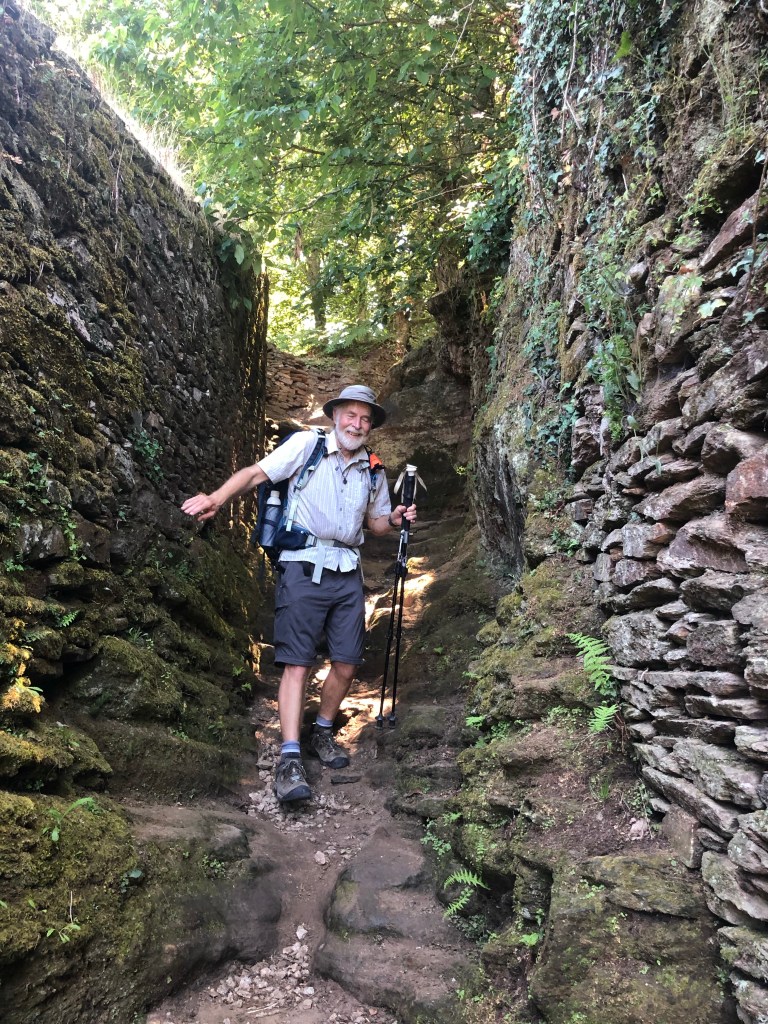
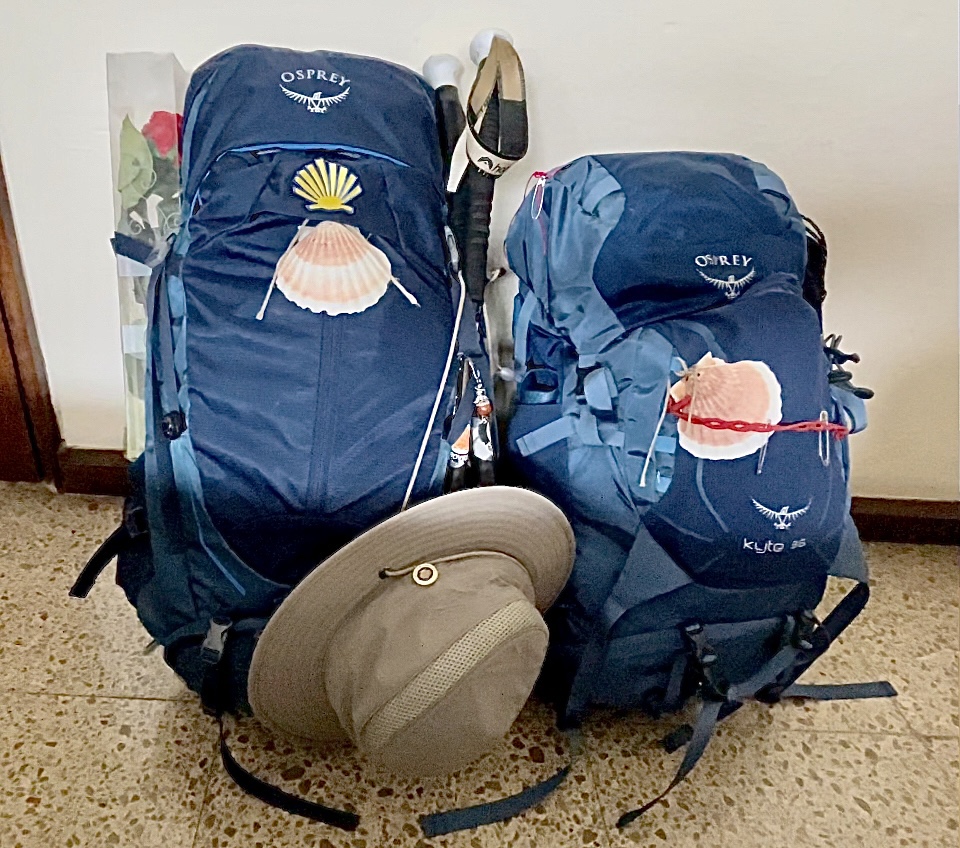
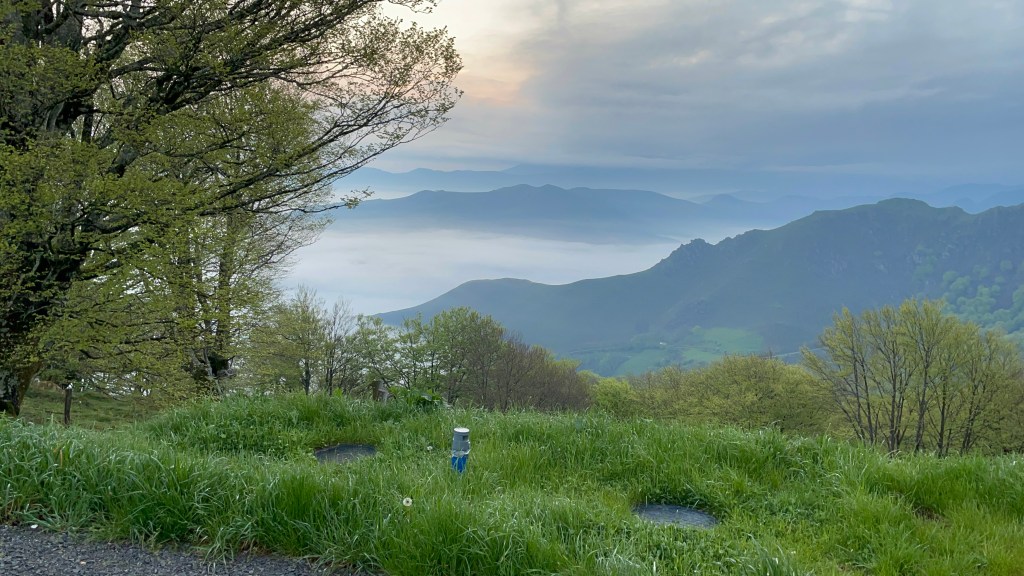
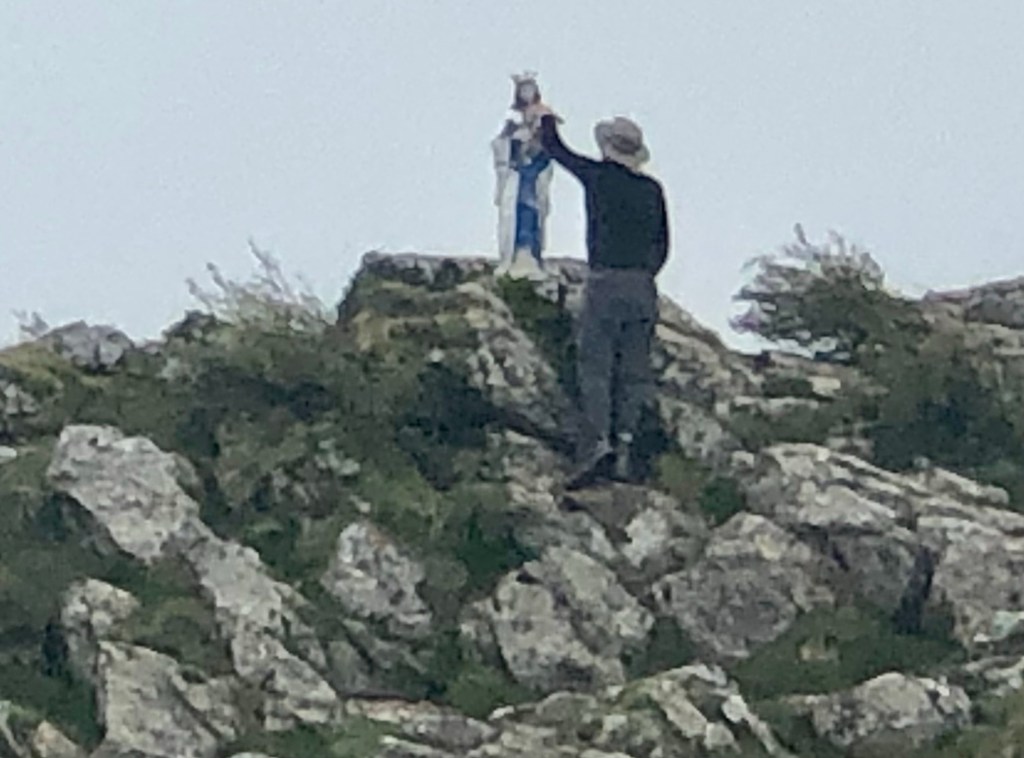
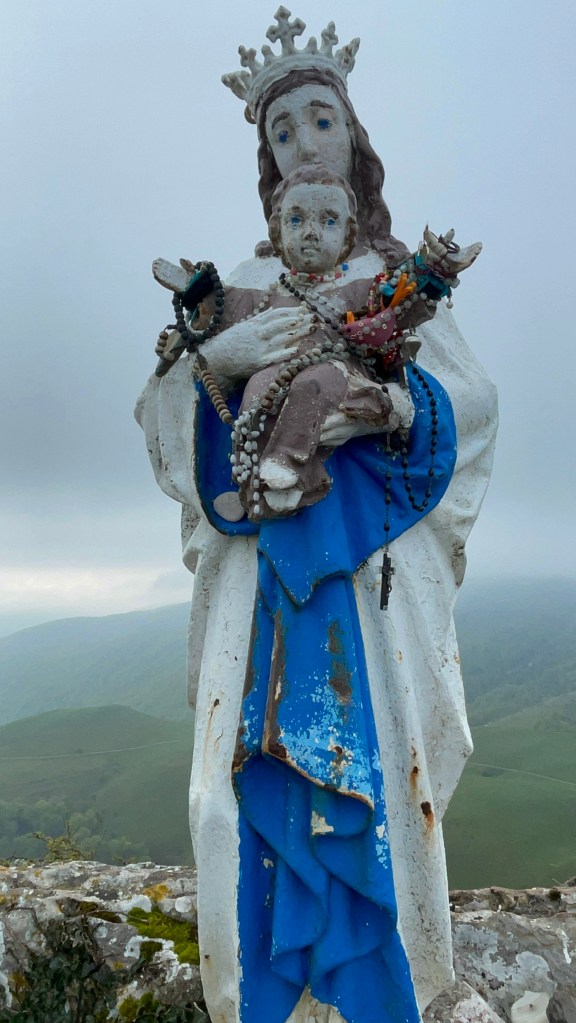


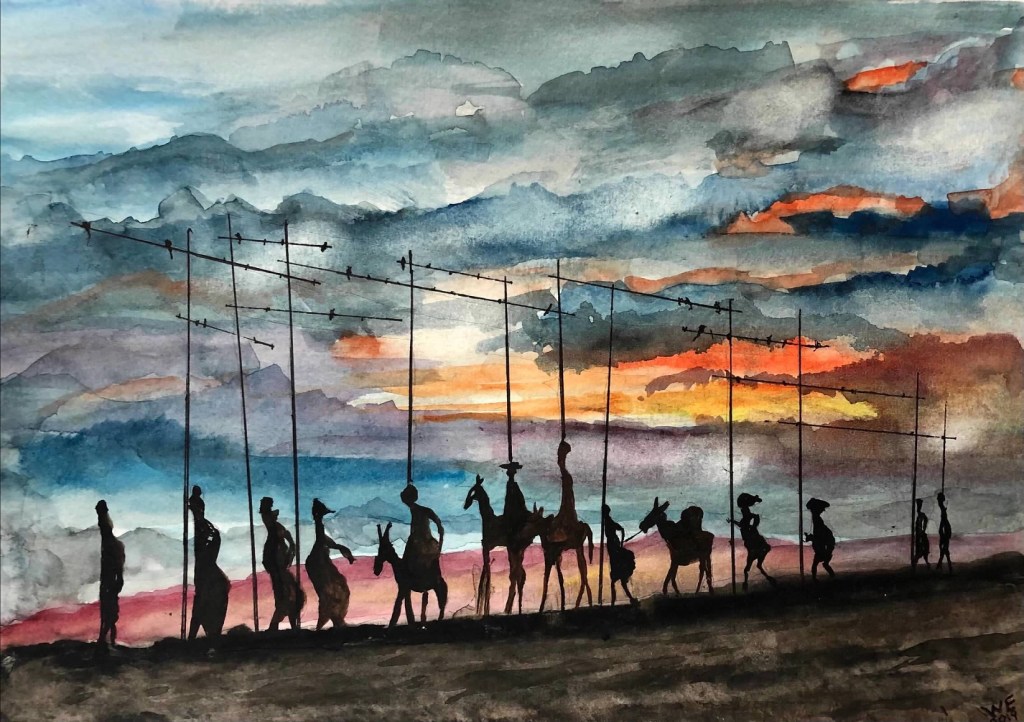
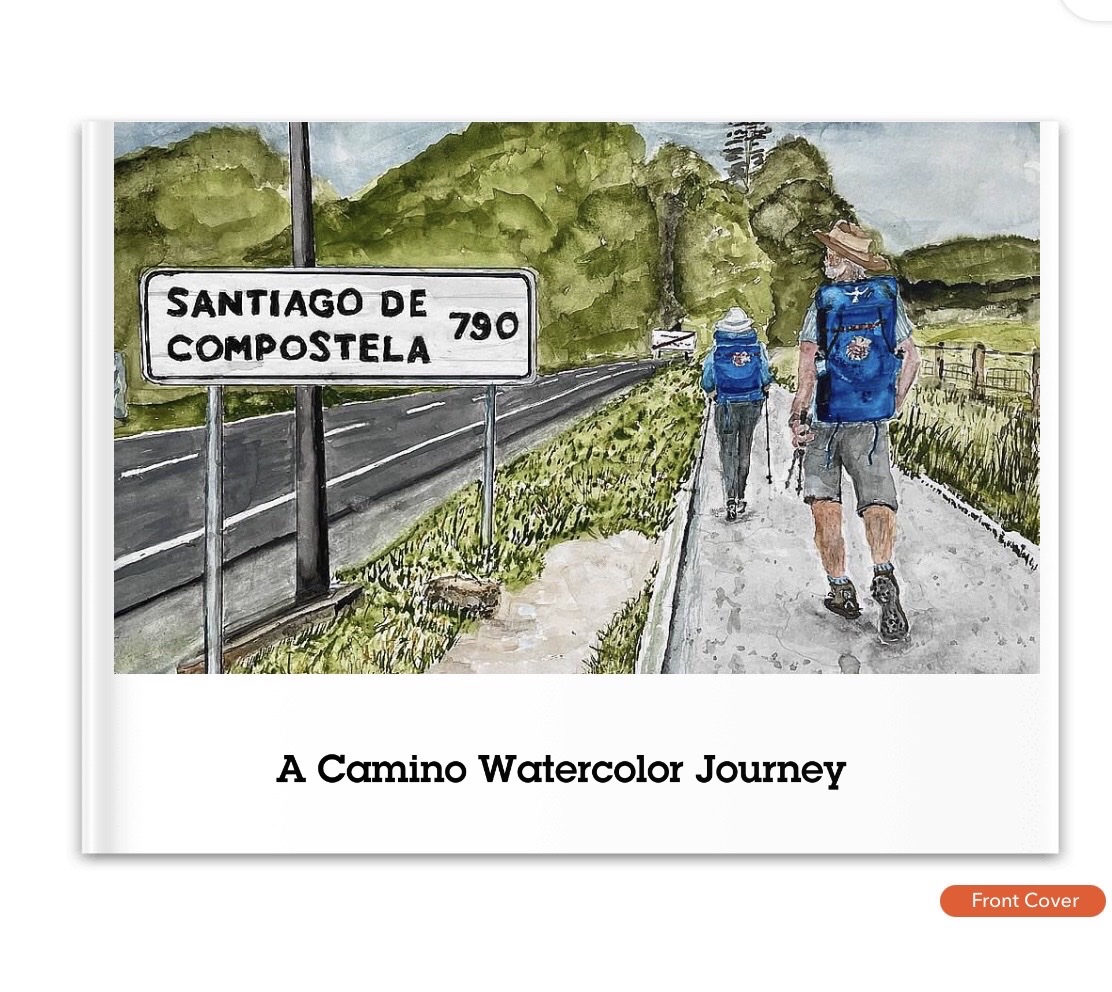

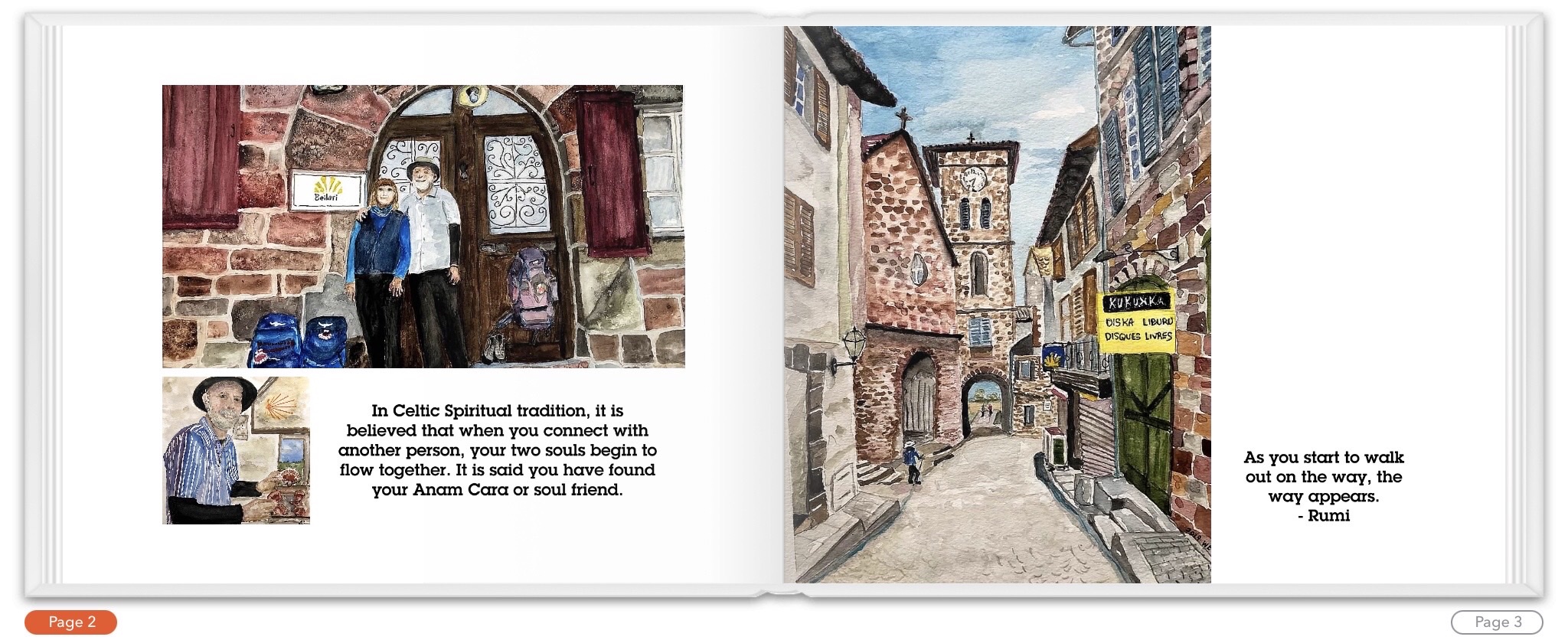

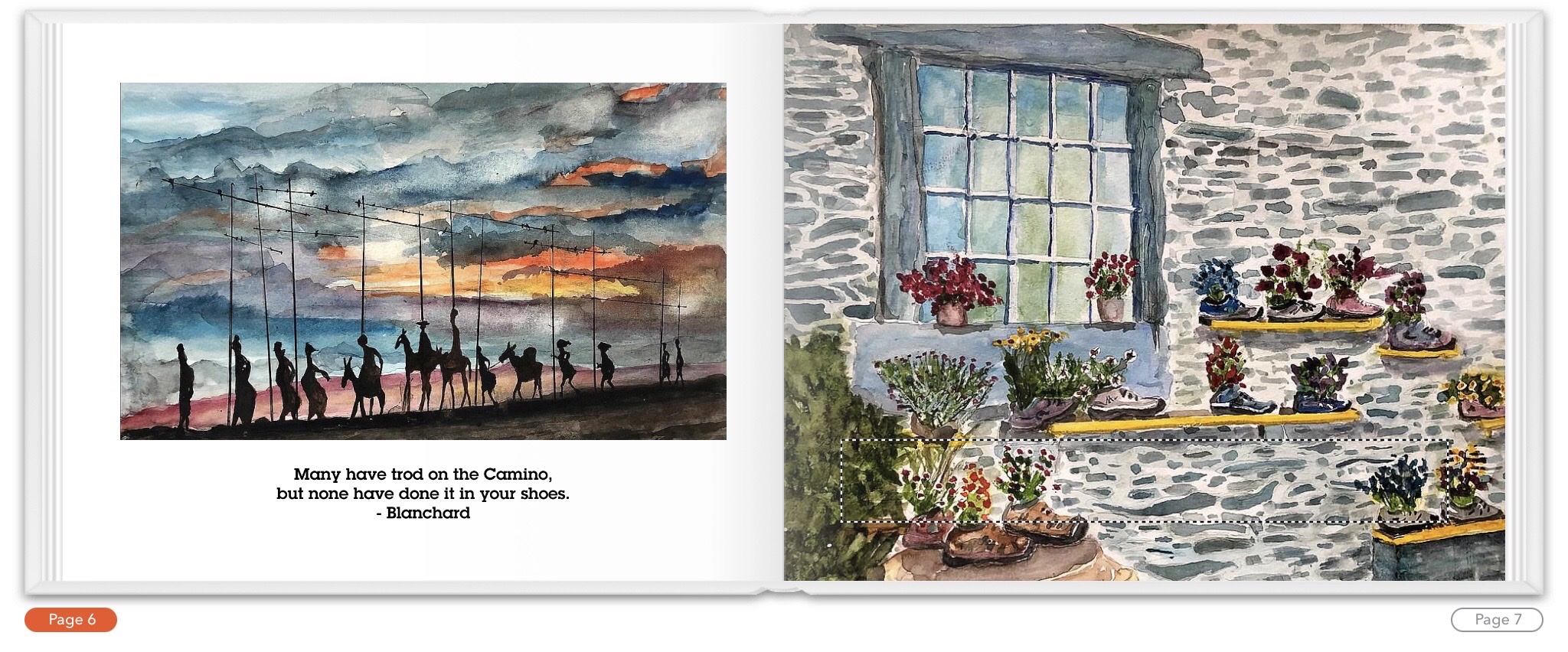
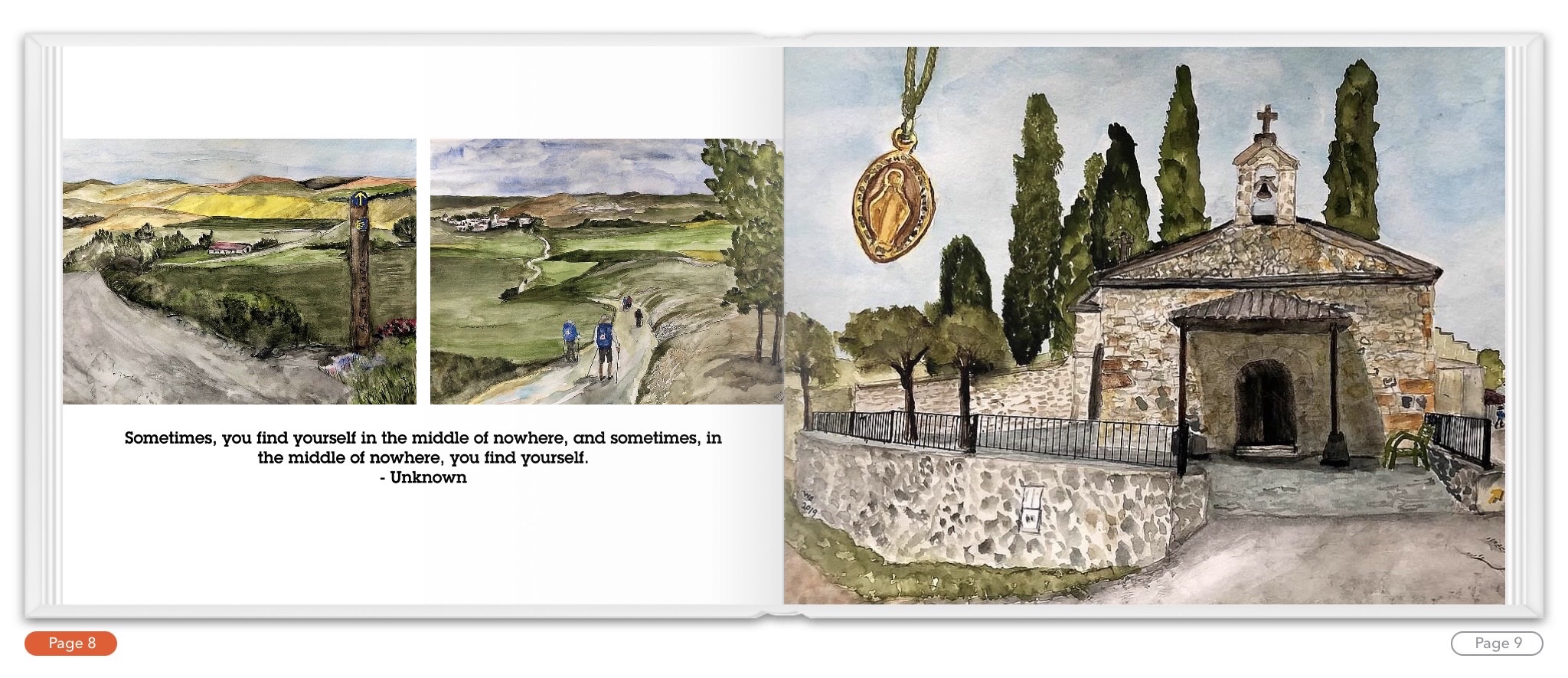
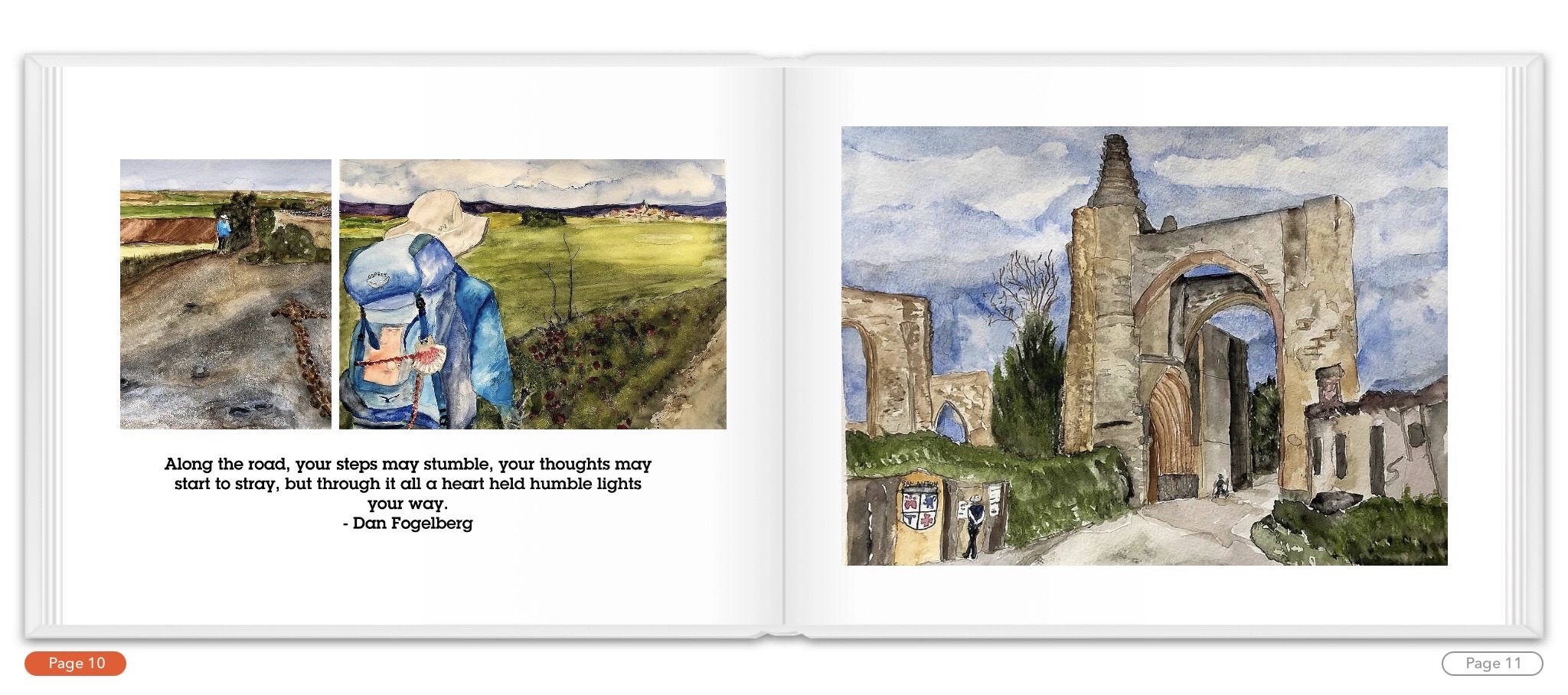
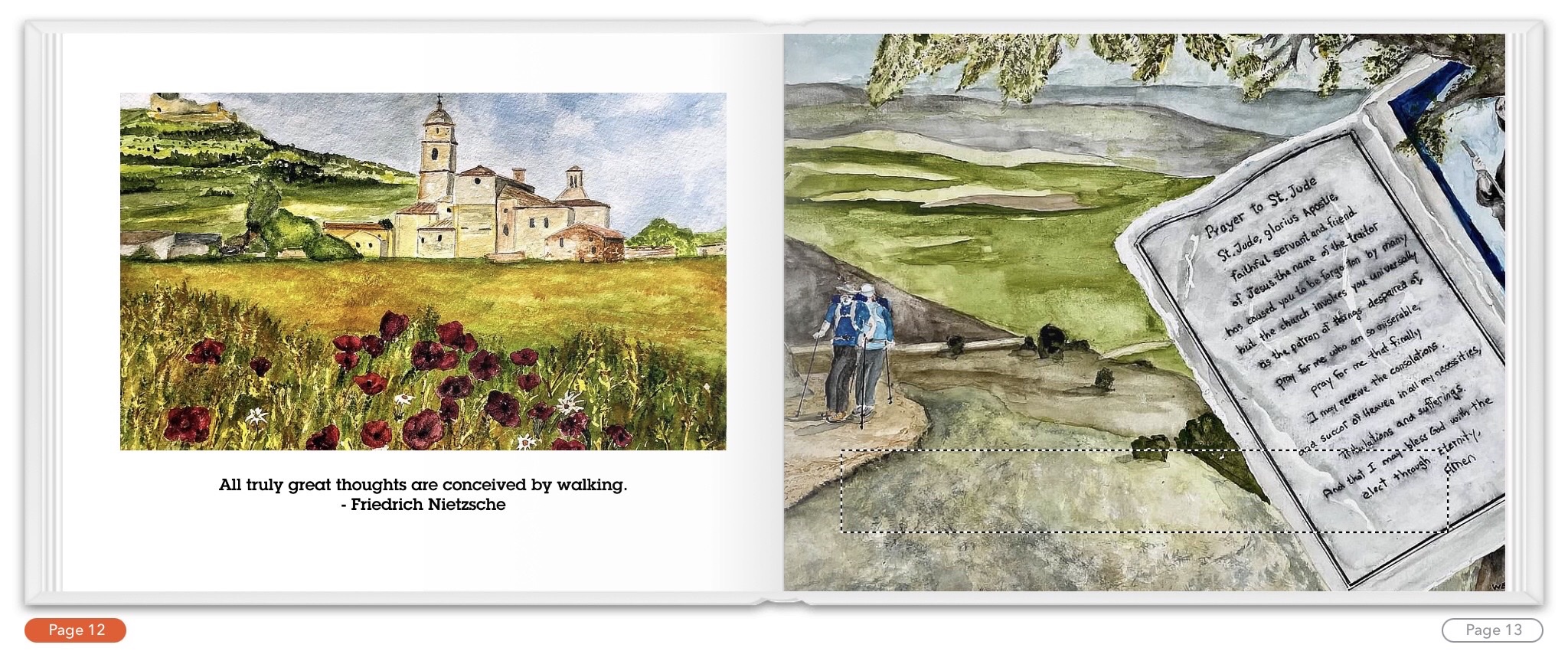
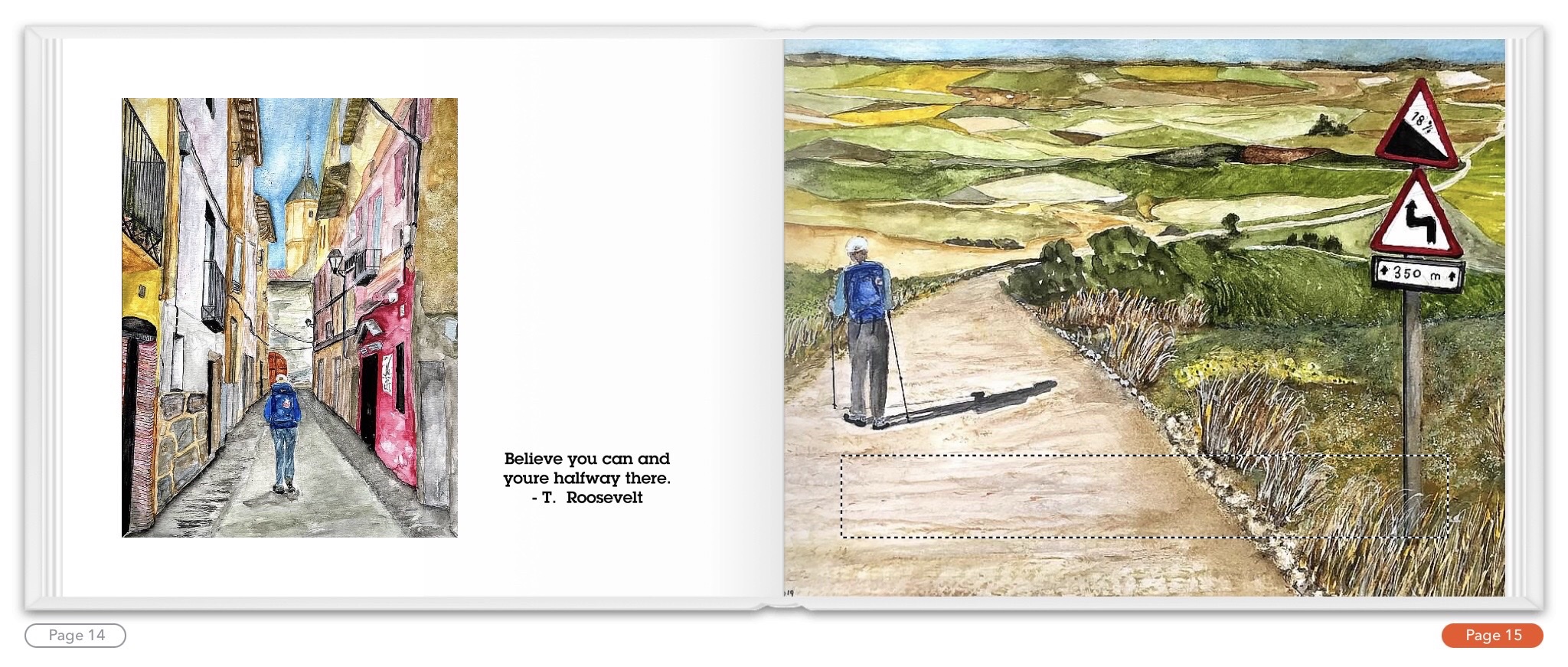
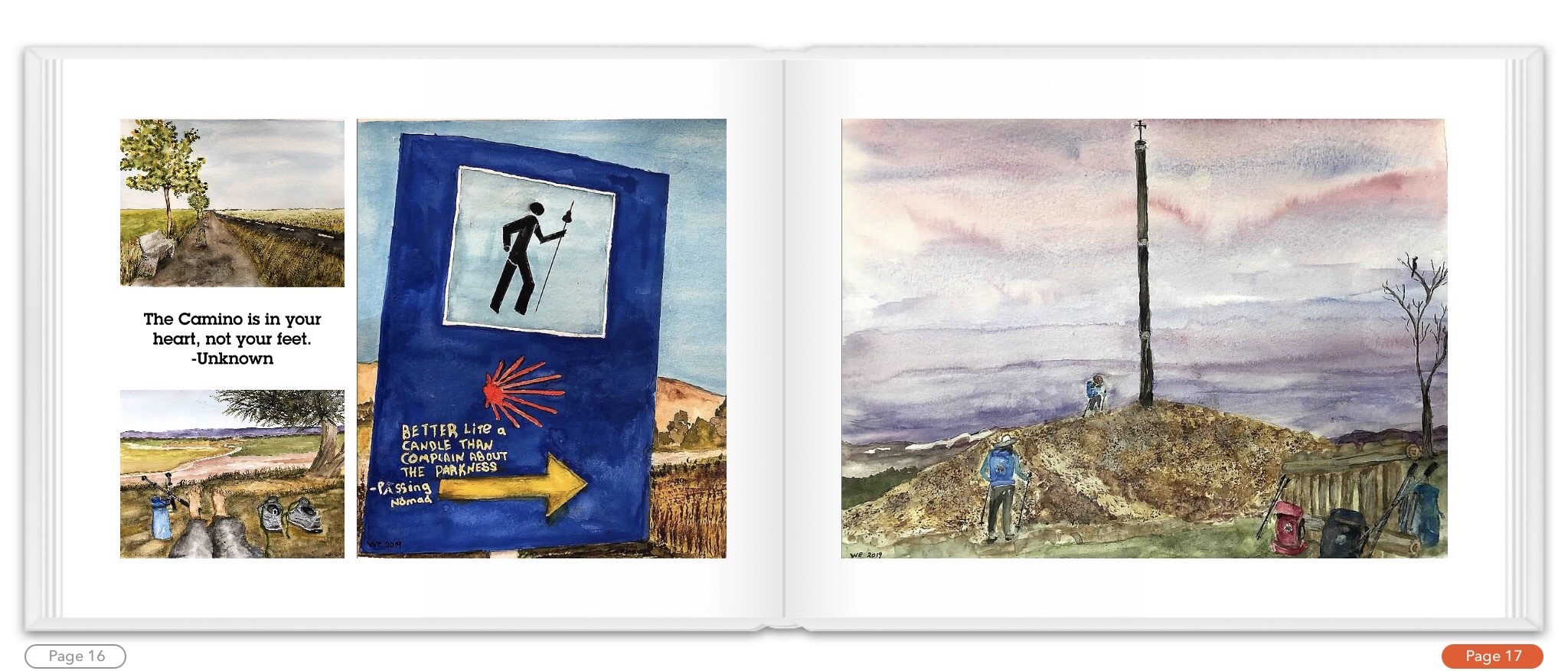
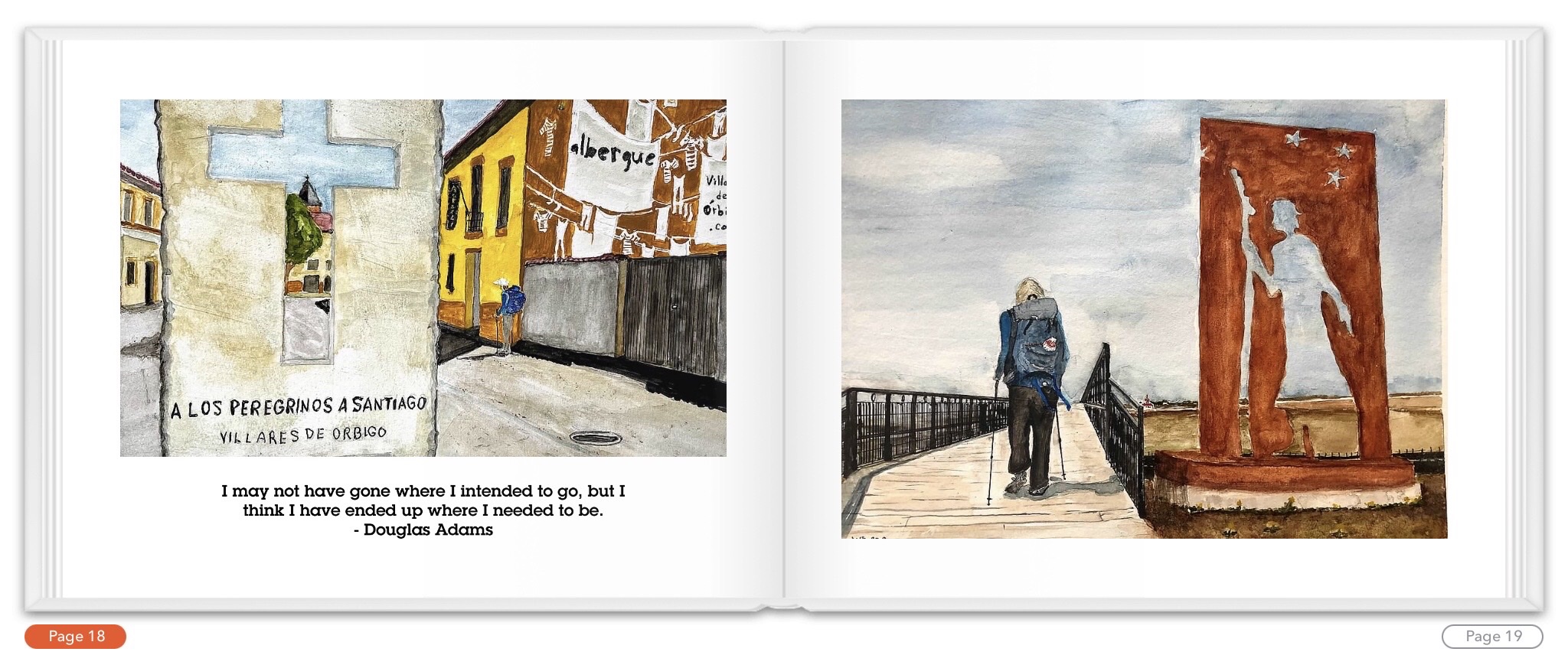

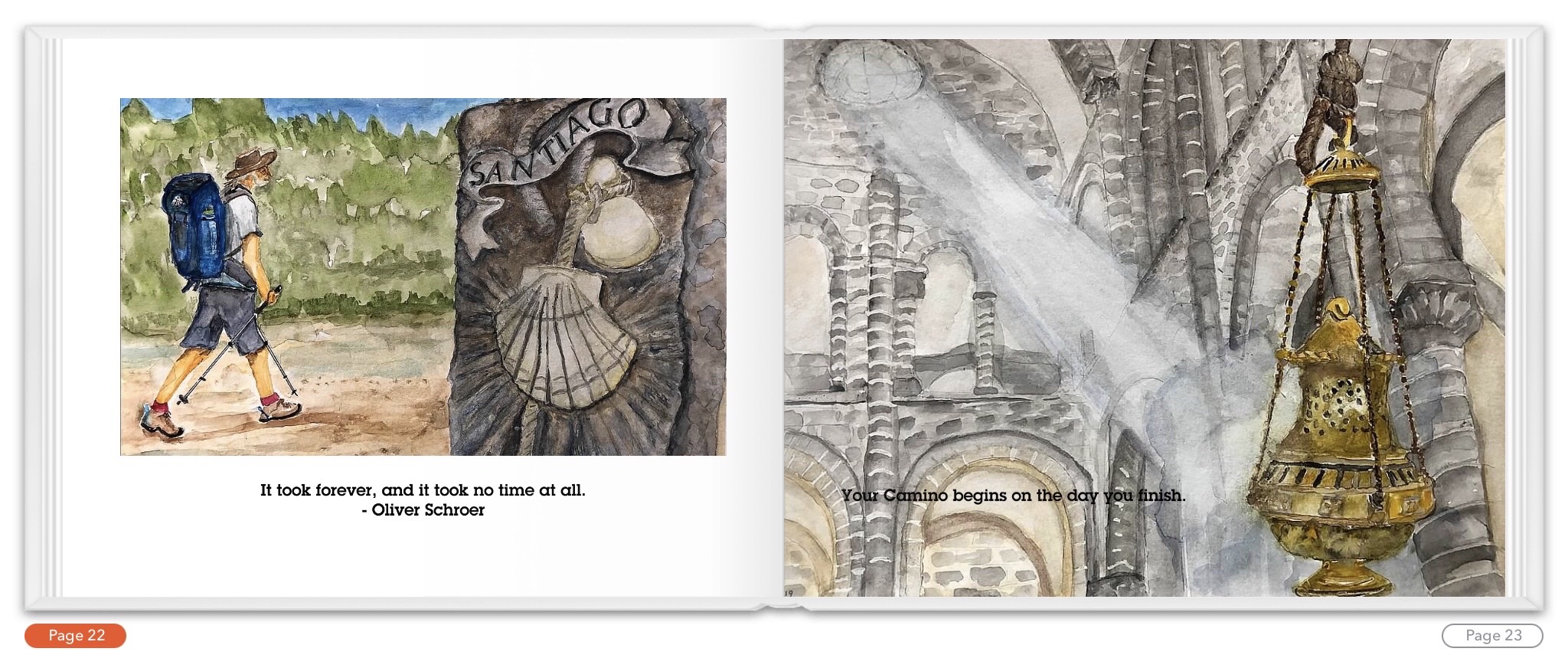
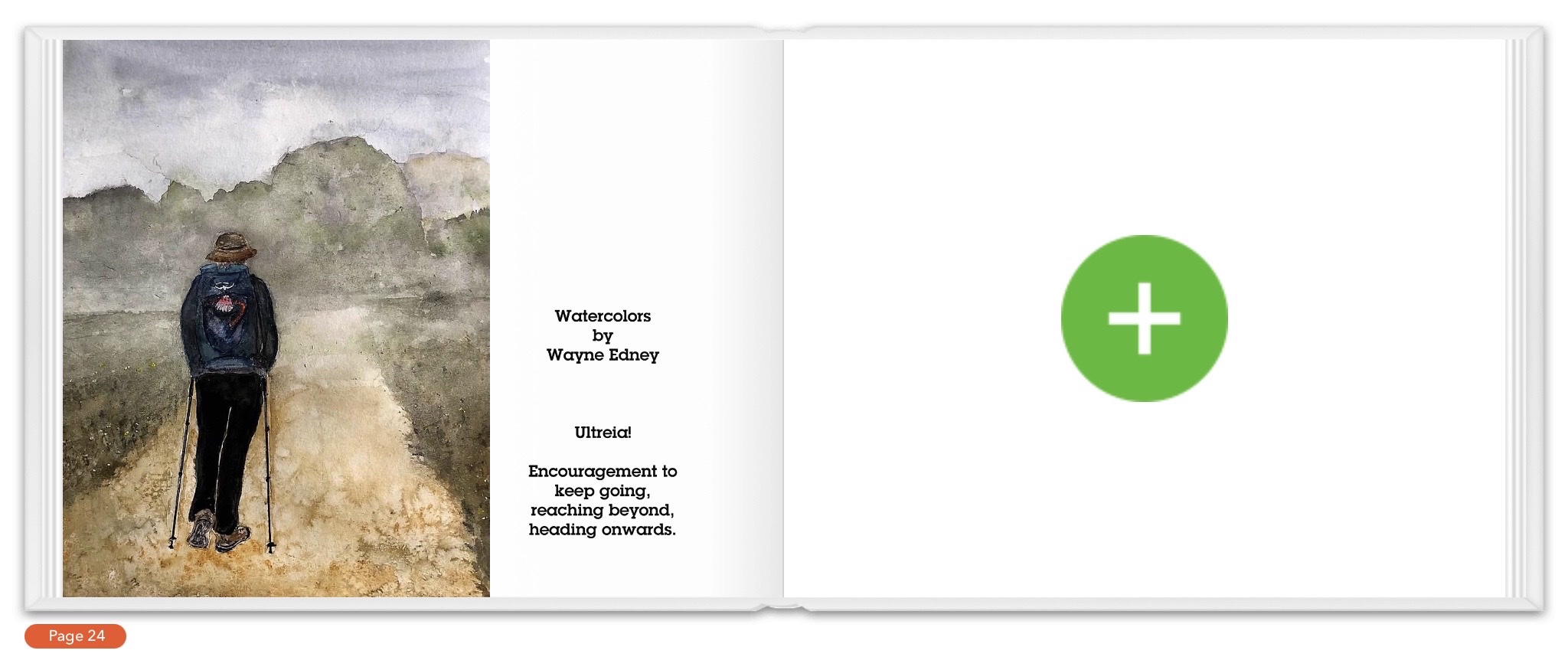

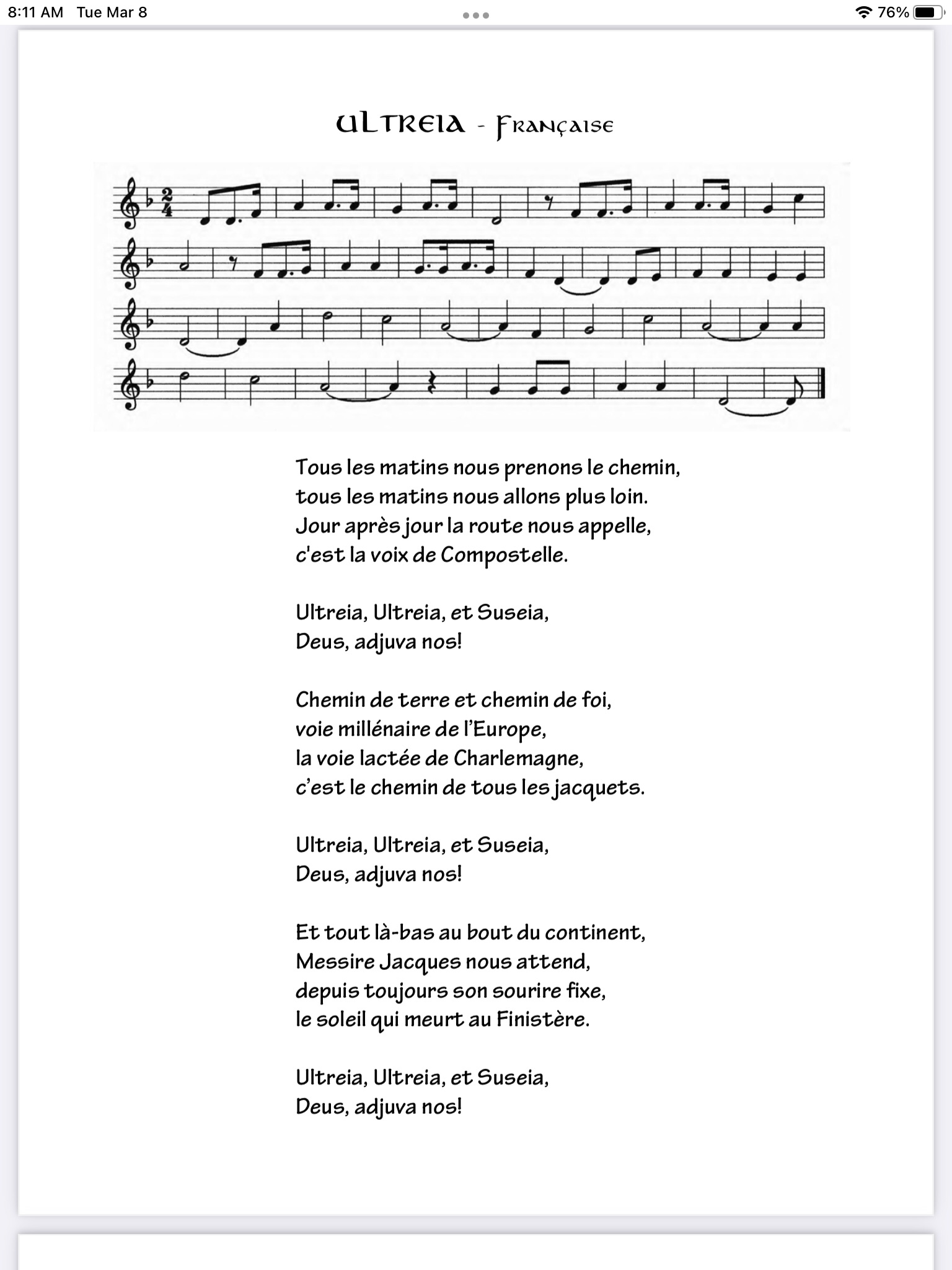
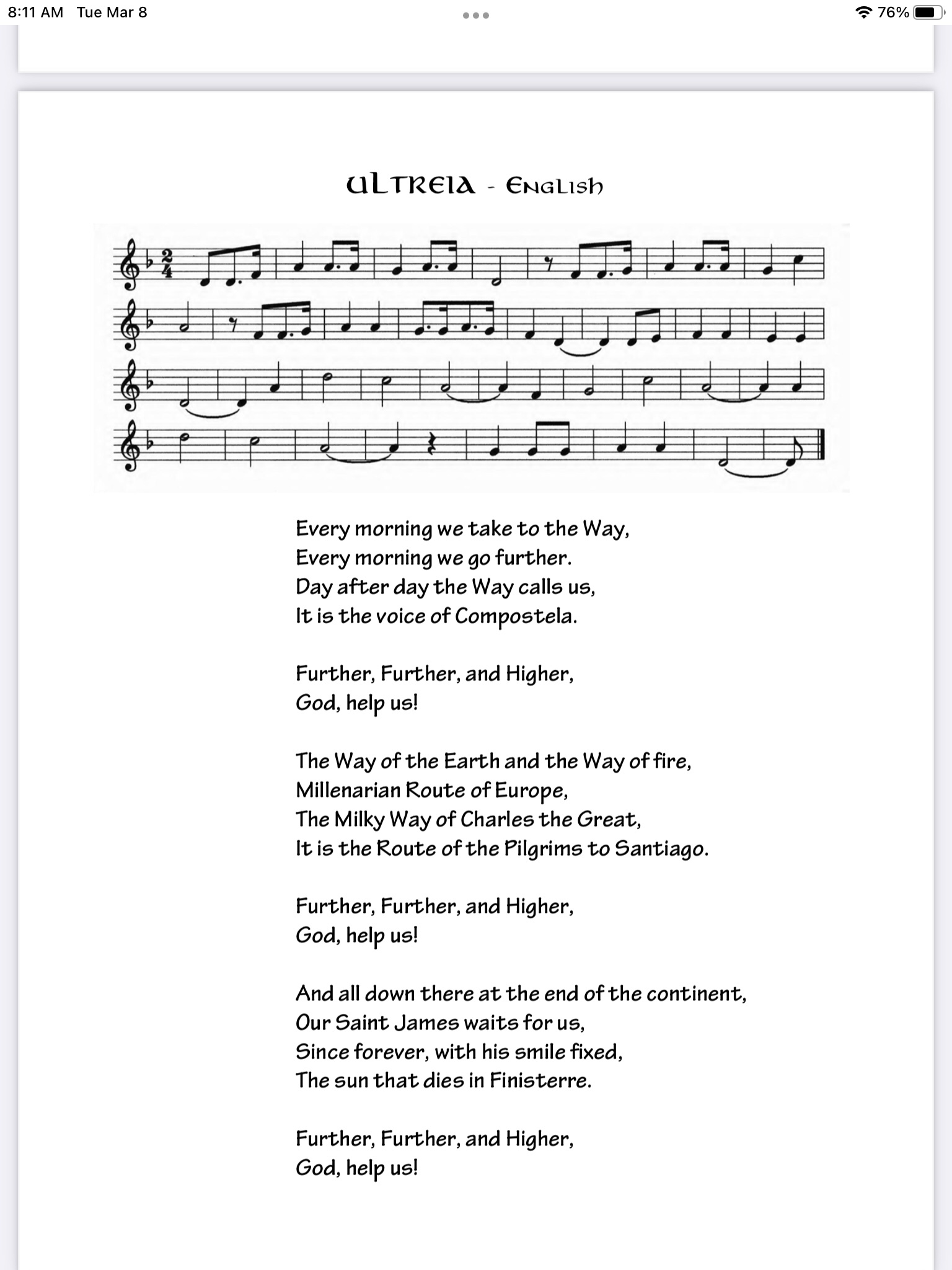
 Somewhere Along the Way